

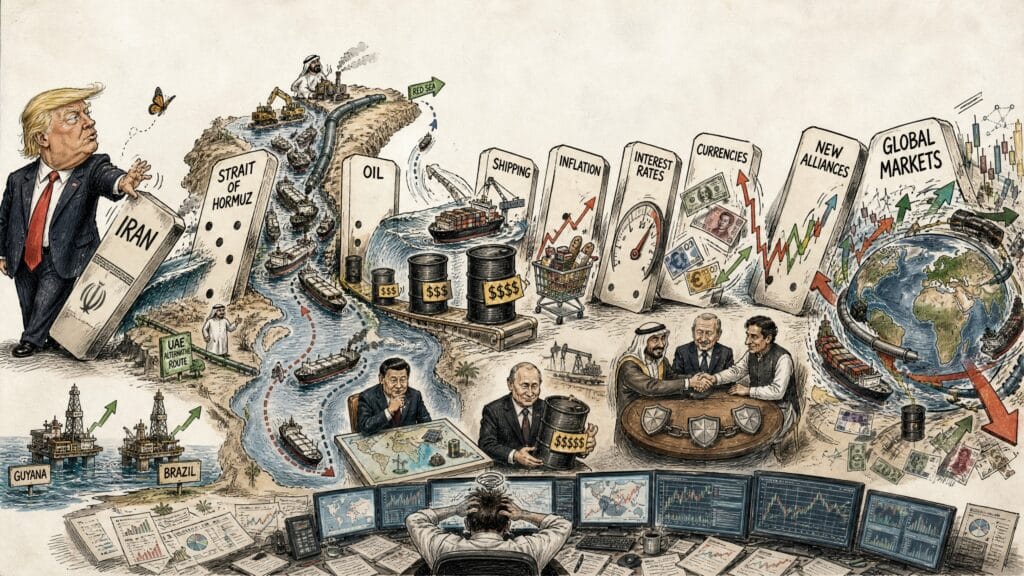
There is a wonderful idea in chaos theory known as the butterfly effect: a butterfly flaps its wings in one part of the world and, through an absurdly complicated chain of consequences, contributes to a storm somewhere else.
The Iran war is rather like that, except the nice gentle butterfly is the somewhat more aggressive United States military, the wings are cruise missiles and the resulting storm has so far involved thousands of deaths, billions of dollars, ballistic missiles, drones, disrupted shipping and an increasingly expensive trip to the petrol station.
Whatever you think about Donald Trump's decision to go to war with Iran, something much bigger is now happening.
Perhaps you believe the US and Israel were right: that Iran represented an intolerable nuclear threat and eventually somebody had to do something about it. Perhaps you believe Trump has blundered into precisely the sort of Middle Eastern war he spent years promising America it wouldn't fight. Perhaps you're among those who noticed that the strikes arrived amid the continuing political toxicity surrounding the Epstein files and wonder whether a foreign crisis was, at the very least, extraordinarily convenient for changing the subject.
That last theory has been advanced by everyone from Trump critics to Joe Rogan, although, I have been urged to make it clear, that there is no tangible evidence establishing that the release of the redacted Epstein files (in which Trump is mentioned more often than Harry Potter is in the Harry Potter books) was a motive for going to war. (Washington Post) I want to be clear on that.
You can sit anywhere along that spectrum, because happily this isn't an article about whether the original decision was correct.
It's about what is happening next.
Six months ago, outside oil markets, shipping and geopolitical circles, I suspect a significant proportion of the world's population couldn't have pointed to the Strait of Hormuz on a map.
Now we could probably organise a pub quiz round on it.
Hormuz has become perhaps the most discussed waterway since the Suez Canal, and with good reason. Before the war, roughly a fifth of the world's petroleum liquids consumption passed through this narrow strip of water between Iran and Oman. It is one of those geographical accidents upon which the modern economy has inexplicably decided to balance itself.
Then Iran demonstrated what happens when the accident stops cooperating.
Oil flows through Hormuz collapsed. Prices rose. Shipping costs increased. Insurance became more expensive. Qatar's LNG exports were hammered. Countries dependent on Gulf energy suddenly discovered that "energy security" is considerably more interesting when the energy isn't arriving.
Aramco estimates that the disruption since February has effectively removed 2.6 billion barrels of oil from the global market, nearly a month's worldwide supply. Its chief executive says that even if Hormuz reopened immediately, replenishing inventories could take around eighteen months at a rate of 2.1 million barrels a day. (Reuters)
So bear in mind that this is no longer a temporary inconvenience. It is an entire behavioural change. And when behaviour in markets change, things get interesting.
Here is one of the great ironies of the war.
For decades, Iran's proximity to the Strait of Hormuz has given Tehran extraordinary strategic leverage. Threatening shipping through it is effectively threatening a significant chunk of the world's energy supply.
But if you repeatedly demonstrate that a road can be closed, eventually people build another road.
Saudi Arabia has massively increased the use of its East-West pipeline, moving crude across the country to Yanbu on the Red Sea rather than sending it through Hormuz. Saudi exports from Yanbu rose from around 2 million barrels a day before the war to more than 5 million by early June. The UAE, meanwhile, has been pushing crude through its Habshan-Fujairah pipeline, which reaches the Gulf of Oman without entering Hormuz at all. (IEA)
The UAE is now expanding that route. Iraq, brutally exposed by its dependence on Hormuz, is looking again at routes through Turkey, Syria and Jordan. France and Saudi Arabia are discussing alternative trade corridors. Across the region, infrastructure that once looked expensive suddenly looks rather sensible.
Iran has demonstrated the enormous power of its geographical position so effectively that it has given everybody an incentive to reduce that power permanently.
There must be a military term for this. I suspect it's something more sophisticated than "ah. Bollocks".
The consequences stretch much further than the Gulf.
If you're an oil importer looking at tankers, missiles and an Iranian-controlled chokepoint, oil produced somewhere that doesn't involve sailing past Iran suddenly acquires an additional attraction.
Enter some unlikely beneficiaries.
Guyana is rapidly becoming a major oil producer. Brazil is expanding offshore production. Argentina has Vaca Muerta. Canada has increased its ability to export westwards towards Asian markets. Namibia has attracted enormous interest following major offshore discoveries, while Senegal and Ivory Coast are developing their own production. But before we get ahead of ourselves, we must not that these countries aren't going to replace the Gulf. The scale isn't remotely comparable.
But the market doesn't require them to replace it. It simply requires them to become more important at the margin.
The Times describes the emergence of these geographically safer producers as a new generation of petrostates benefiting from the post-Hormuz world. (The Times)
That's a profound second-order effect. A war intended partly to constrain Iranian power may ultimately accelerate investment in oil infrastructure thousands of miles from Iran, altering trade routes and redistributing geopolitical influence for decades.
Fermat's Last Theorem took mathematicians more than 350 years to solve.
Middle Eastern geopolitics post the 3rd Gulf War appears determined to produce a more complicated equation before breakfast.
Energy isn't the only system being redesigned.
Earlier this month, Saudi Arabia, Turkey and Pakistan signed the Mecca Joint Defence Agreement. Its central promise sounds suspiciously familiar: an armed attack against one member is to be treated as an attack against all.
Turkey's foreign minister has explicitly compared the mechanism to NATO's Article 5. But this isn't NATO. There is no equivalent integrated command structure, decades of institutional development or American military umbrella behind it. For now, it is better understood as an emerging regional security framework. (Reuters)
Nevertheless, consider what has just been assembled.
Saudi money and energy power.
Turkey, a NATO member with the alliance's second-largest army and a formidable domestic defence industry.
And Pakistan, with one particularly noteworthy item on its military CV:
nuclear weapons.
Egypt may eventually join. Qatar, Kuwait, Syria and Azerbaijan have also been discussed in the wider orbit of the emerging arrangement. (The Times)
Officially, this isn't an anti-Iran alliance. All three countries maintain relationships with Tehran and Pakistan has been involved in mediation. Nor is it formally an anti-Israel alliance-that ambiguity is probably the point.
These countries have spent decades living beneath an American security architecture. The Iran war has forced them to ask an uncomfortable question: what happens if we can no longer assume America will always provide the architecture?
The answer appears to be: build some scaffolding of your own.
This is where I keep thinking about Umberto Eco's Foucault's Pendulum.
For anyone who hasn't read it, three publishing-house intellectuals essentially invent an enormous conspiracy theory for intellectual amusement, connecting the Knights Templar, secret societies and assorted historical mysteries into "The Plan". The problem is that other people begin believing it. Eventually the invented conspiracy starts producing real-world consequences.
The creators lose control of the thing they created.
There is something strangely relevant about that idea here.
States make decisions based on the world as it currently exists. America attacks Iran to prevent one set of future outcomes. Iran closes Hormuz to create leverage. Saudi Arabia reroutes oil to avoid Iran's leverage. Other countries increase production to exploit the shortage. Gulf governments form new security relationships because the war has changed their assessment of American protection.
Each action is rational when viewed from inside itself.
Together, they create a world nobody actually designed.
And once that world exists, you can't simply put everything back where it was. Especially given that the world now has had to react to what has happened (for whatever reason it started) when America launched that first attack. Whatever conspiracy you want as the motive everyone is reacting to the circumstances.
Like enthusiastic voyeurs, watching, mostly. And not necessarily unhappily.
China has a huge problem because it remains heavily dependent on imported energy. More than 80% of Iran's shipped oil had been going to China, but Iranian supply has collapsed under the US blockade and the Hormuz disruption. Chinese refiners are now scrambling for alternatives including Brazilian and Iraqi crude. (Reuters)
That hurts Beijing in the short term.
Strategically, however, the broader lesson is obvious: depending on maritime energy routes vulnerable to American military power is dangerous. Expect China to keep diversifying suppliers, building reserves, expanding pipelines and investing in energy sources that cannot be interrupted by somebody parking an aircraft carrier nearby.
Russia's position is even more peculiar. Disruption to Gulf oil makes Russian crude more valuable to buyers seeking alternatives. India, for example, is now importing more than 2.6 million barrels of Russian oil per day, more than half its crude imports, as Gulf supplies have become less dependable. (Financial Times)
A war against Iran can therefore create additional demand for Russian oil.
Geopolitics does enjoy a joke.
This is where the story comes back to us.
If you're trading oil, the obvious temptation is to stare at Hormuz and wait for the next missile, ceasefire announcement or Trump post. (Or pay $100k a month for the privilege)
But the more interesting trade may be the structural change underneath it.
Oil markets are gradually learning to price route security, not simply production. Pipeline capacity matters more. Export geography matters more. Guyana matters more. Brazil matters more. Russian flows to India matter more. Saudi infrastructure on the Red Sea matters more. UAE capacity at Fujairah matters enormously.
And the consequences don't stop at crude.
More expensive energy feeds inflation. Inflation changes interest-rate expectations. Interest rates move currencies. Higher transport and insurance costs hit trade balances. Countries that import most of their energy become more exposed; exporters and alternative producers gain leverage.
The FX trader looking only at the dollar or dirham on the screen is therefore still trading Hormuz, whether they realise it or not.
The Times identifies six increasingly interconnected zones of instability stretching far beyond what we traditionally call the Middle East, from the Gulf and Levant through the Red Sea and into Africa and Europe. The important point isn't the precise geographical label. It's that these markets can no longer be analysed neatly in isolation. (The Times)
Oil affects inflation. Inflation affects rates. Rates affect currencies. War affects shipping. Shipping affects prices. Prices affect elections. Elections affect foreign policy.
Pull one thread and the whole bloody jumper starts unravelling.
Eventually this war will end. All wars do.
What won't necessarily end with it are the pipelines that have been built, the suppliers that have been discovered, the alliances that have been signed and the assumptions that have been broken.
That's the real lesson in unintended consequences.
The most important result of an action isn't always the thing it was intended to achieve.
In this case, it's what everybody else does in response.
Iran demonstrated that Hormuz could be weaponised. The Gulf responded by learning how to live with less of it. Saudi Arabia, Turkey and Pakistan started constructing a security arrangement that depends less completely on Washington. New oil producers suddenly became strategically interesting. China and India began adapting their supply chains. Russia found new demand.
None of those things required anybody to sit down and design a new world order.
It emerged.
The butterfly flapped its wings.
Except this time it wasn't a butterfly. It was a war.
And for traders, the challenge isn't simply predicting where the next missile lands. It's understanding where all the ripples eventually wash up.
Keep your Axe sharp - you will be needing it.
Max
Want more of The Daily Chop?
Sharp market stories, trading takes and financial madness straight to your inbox.

