

There is a photograph accompanying a Max Hastings column in The Times that, in its own rather wonderful way, captures something about the current White House. Katie Zacharia, briefly Donald Trump's press secretary, is standing behind the podium looking polished and presidential beneath the familiar blue backdrop. Hastings's headline is rather less diplomatic: “Fakers tussle for seats at Trump's table of lies.” His argument is essentially that something dangerous happens when lying, exaggeration and bullying become so routine that everybody simply begins treating them as part of the furniture.
We've already looked in this column at another extraordinary feature of Trump's second presidency: the amount of money accumulating around the President and his family. Trump has become considerably richer while occupying the White House, his family has expanded into crypto and overseas business, and the traditional boundary between public office and private commercial opportunity has become sufficiently blurred that you occasionally need a magnifying glass to find it. But put the money to one side for a moment, because I think something broader and perhaps more interesting is happening. Is Donald Trump entering the fuck-it stage of his presidency?
I don't mean that medically, psychologically or as some grand prediction that the presidency is collapsing. We've been hearing that Donald Trump is finished for more than a decade, during which time he has been impeached twice, lost an election, faced multiple criminal prosecutions, been convicted of 34 felonies, survived political scandals that would have vaporised almost any conventional politician and then returned to the White House. Anyone confidently announcing “the end of Trump” at this stage should probably also have a look at my collection of guaranteed Grand National winners.
I mean something much simpler. Trump cannot run for another term under the Constitution. The midterm elections arrive on November 3. His approval rating has fallen to 31 per cent in the latest Reuters/Ipsos poll, the lowest Reuters has recorded across either of his presidencies, while Democrats held a 47–35 advantage among registered voters on the generic congressional ballot. Those national numbers do not translate neatly into seats, particularly after redistricting, and Democrats face a much harder route to the Senate than the House. I'll do a proper Daily Chop midterm special before polling day rather than pretending a national poll tells us who will control Congress. But politically, the clock is undeniably ticking.
And I increasingly wonder whether that ticking clock explains something about the behaviour we're watching.
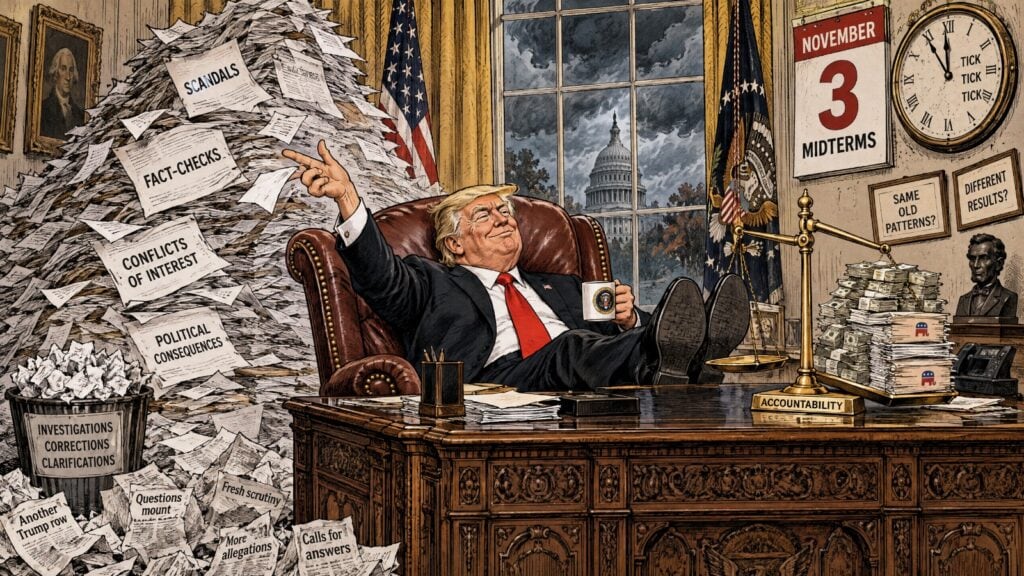
Most politicians spend their careers constrained by the future. They want another term, promotion, donors, the party behind them and eventually some sort of respectable legacy. They want the newspapers to be nice about them when they finally open a library and begin charging £150,000 for speeches about leadership. Trump has always been unusually resistant to those constraints, but now several of them are disappearing altogether. There is no next presidential election for him to win. He has reshaped the Republican Party so comprehensively around himself that internal opposition carries enormous political risk. He has already demonstrated that scandals which would once have been considered career-ending do not necessarily end his career, and even his legal history has failed to impose the political consequences that conventional wisdom assumed it would.
That creates a fascinating question about incentives. What restrains somebody who has repeatedly discovered that the things everybody said he couldn't do were, in fact, things he could do? If touching the electric fence repeatedly produces no electric shock, eventually you stop treating it as an electric fence.
That is why I don't think the interesting story of this presidency is any longer a single scandal, a single lie or a single extraordinary business arrangement. It is the cumulative erosion of the idea that there is a meaningful line somewhere. Trump crosses one, discovers that his political support survives, and the next line becomes easier to cross. Something that would have dominated American politics for six months fifteen years ago can now struggle to survive a Tuesday afternoon.
This is where Hastings's argument becomes interesting. The Washington Post attempted something extraordinary during Trump's first presidency: it catalogued his false or misleading statements. The final number was 30,573 over four years. What is more revealing than the total is the acceleration. According to the Post, Trump averaged roughly six false or misleading claims a day during his first year, 16 in his second, 22 in his third and 39 a day in his fourth.
That progression tells its own story. If telling demonstrable untruths produced an intolerable political penalty, you would expect the number to decline. Instead it increased dramatically. Trump discovered something about modern politics that may prove considerably more important than any individual Trump policy: a statement doesn't necessarily have to remain true for very long to be politically useful.
Say something. Make it enormous. Let television repeat it. Let social media fight about it. If somebody produces the correction tomorrow, move on to something else. Hastings picks out Trump's extraordinary treatment of Ukraine as an example. Trump has repeatedly described the scale of American assistance using numbers that do not correspond with documented US totals. He has also publicly blurred the distinction between weapons discussed, requested and actually supplied. We've looked at this before with the supposed $350 billion America had given Ukraine and with Tomahawk missiles, which Trump discussed in language that could easily leave a listener believing they formed part of weapons already being sent even while Volodymyr Zelensky, standing beside him, was asking to receive them.
The important thing isn't simply whether Trump gets a number wrong. Politicians get numbers wrong all the time. I probably get my children's ages wrong if you ask me before coffee. The difference is what happens afterwards. With Trump, correction rarely seems to produce correction. The original claim simply becomes another version of reality competing with the documented one, and eventually the sheer volume becomes its own defence. You cannot be scandalised by everything indefinitely. Human beings simply don't have the administrative capacity.
Perhaps this is Trump's greatest political innovation. Not lying; politicians managed that perfectly well before he arrived. Volume. One false statement can become a scandal, ten can become a pattern, but ten thousand become weather. You wake up, see another extraordinary Trump statement and barely register it because there was one yesterday and there will probably be another tomorrow. The abnormal becomes normal through repetition and the outrage mechanism eventually overheats.
That, I think, is the most important part of Hastings's argument. He warns against “normalising the president's lying and bullying”, because normalisation doesn't mean people start believing everything Trump says. It means they stop expecting anything different, and there is an enormous distinction between the two.
If a conventional president made a demonstrably false statement, the story was once President Made False Statement. With Trump, the falsehood itself can become secondary to whatever larger political argument is happening around it. His supporters may regard the fact-checker as partisan. His opponents already assume he's lying. The media reports it, everybody retreats to their respective trenches and nothing materially changes. Trump has effectively benefited from expectations management in reverse. The bar is now lying on the floor.
Which brings us back to the extraordinary expansion of Trump's wealth and family business interests during his second presidency: crypto ventures, meme coins, foreign developments, access to the President being connected to ownership of a Trump-linked token, and the general question of where American public power ends and Trump family commercial opportunity begins.
The argument there is about self-enrichment. The question here is why Trump apparently feels comfortable doing so much of it in plain sight. Perhaps the answer is simply that experience has taught him to be comfortable. If every previous controversy that was supposed to destroy you failed to destroy you, why would the next one frighten you? If voters knew about your businesses and elected you anyway, why behave as though those businesses are politically radioactive? If accusations of conflicts of interest have been circulating for a decade without meaningfully dislodging your support, why suddenly become punctilious about appearances now?
And if, as has been alleged but emphatically not established, Trump privately wants to leave office worth $20 billion, why wouldn't he pursue that objective aggressively if he believes the political cost is negligible? This is not an accusation that Trump has secretly decided to loot America before January 2029. There is no evidence establishing such a plan. It is a question about incentives, and incentives matter because they are how we understand behaviour in almost everything else. Markets certainly understand them.
Suppose you invested in a business whose chief executive was approaching the end of his non-renewable contract. He could not remain CEO afterwards. During his tenure his personal commercial interests had expanded enormously, his family had become involved in businesses overlapping with areas affected by company decisions, and the board had repeatedly discovered that behaviour previously assumed to be unacceptable did not actually result in his removal.
Would you become more relaxed about governance as his departure approached? Of course not. You would become more interested in it.
That is why listed companies have rules around related-party transactions, disclosure, insider information, remuneration and conflicts of interest. It isn't because every chief executive is assumed to be corrupt. It is because good governance doesn't require you to know whether somebody is honourable before designing the system. You design the system so honour isn't the only thing protecting you.
American democracy was designed with precisely the same pessimism. The Founding Fathers did not write the Constitution on the assumption that everybody elected president would be a splendid chap. They assumed human beings like power, money and influence, and constructed competing institutions partly to stop any one person accumulating too much of them. The entire architecture is built around the idea that rules matter most when the person being restrained doesn't particularly like them.
This also provides a different way of looking at the extraordinary personnel churn around Trump. Katie Zacharia's five-day adventure as White House press secretary was funny because five days is objectively funny. You barely get your email signature working in five days. But the more revealing story isn't Zacharia herself; it is what constant turnover says about an institution.
Trump has always prized loyalty, and administrations naturally want officials who support their programme. But there is a difference between loyalty to an administration and personal loyalty to an individual. Institutions become fragile when telling the boss something unwelcome becomes career-limiting, because eventually the people most willing to contradict the leader are replaced by people most skilled at agreeing with him.
That isn't specifically a Trump problem. It is a management problem as old as management itself. Roman emperors had it, kings had it, CEOs have it, football managers have it and most of us have encountered some version of it at work. If everyone around the table thinks you're brilliant, there are two possibilities: one is that you're brilliant; the other is that you've stopped inviting people who think you're an idiot.
I came across another opinion piece this week arguing that the White House is now “in retreat on all fronts” as Trump's popularity declines. I think that's going too far. Trump remains President, Republicans still control Congress and the administration continues to wield enormous executive power. Calling this some sort of political collapse would be premature, particularly with Trump, whose career has repeatedly punished people for writing his obituary before checking his pulse.
There are, however, signs of genuine political pressure. Trump's approval is at that Reuters/Ipsos low of 31 per cent. Cost of living dominates voters' concerns, while Reuters found 68 per cent disapproving of his handling of the economy, including 37 per cent of Republicans. His Iran policy has collided with higher fuel prices and Democrats lead nationally on the generic congressional ballot. Trump has returned personally to the campaign trail as Republicans fight to protect their position in Congress. None of that means Republicans automatically lose the midterms. The House and Senate are very different contests, district boundaries matter enormously and the Senate map presents Democrats with a considerably harder mathematical task.
We'll get properly stuck into all of that in the midterm special, because there is an awful lot to unpack. For now, the significance is simpler: Trump is approaching the first meaningful national electoral verdict on his second presidency, and he isn't approaching it from a position of obvious strength.
Not necessarily, and I would be extremely cautious about using that word with Donald Trump. But I do wonder whether we're watching something slightly different: a president increasingly liberated from the incentives that constrain normal politicians. He cannot seek another presidential term. His political movement is overwhelmingly his own. He has survived almost every category of scandal American politics possesses. His family's wealth has grown enormously. His opponents have spent ten years announcing that this time he has finally gone too far, only to discover repeatedly that the line had moved again.
What behaviour should we expect that experience to produce: restraint or escalation? That's the question I think is more interesting than another argument about whether Donald Trump lied on Tuesday. The individual falsehoods matter, particularly when they concern wars, markets or public policy, but something bigger has happened. America has become accustomed to a presidency operating at a level of controversy that would once have overwhelmed the political system.
Hastings is right about the danger of normalisation because democracies rarely announce that their standards have changed. Nobody rings a bell. There isn't a ceremony in the Rose Garden where somebody unveils a plaque saying THE OLD RULES NO LONGER APPLY. Standards move incrementally. Something shocking happens, people shout and nothing happens. Then something slightly more shocking happens and yesterday's outrage becomes the new reference point. Eventually you forget where the line started.
Which is why the midterms are going to be fascinating. Not because they will tell us whether Donald Trump is “finished”. They won't. He remains President whatever happens on November 3. Nor will they provide some perfect national referendum on Trump, because Americans will be voting in hundreds of different races for thousands of different reasons.
But they will alter the incentives. If Republicans retain both chambers despite Trump's approval numbers, the obvious lesson inside the White House may be that the political machine remains remarkably resilient and that predictions of electoral punishment were once again overstated. If Democrats take the House, Trump's final two years become considerably more difficult: investigations, subpoenas and institutional resistance become far more serious possibilities. The Senate matters differently again. We'll do the numbers, seats, probabilities and scenarios properly in the midterm special.
Before that happens, though, I keep returning to a simpler thought. Donald Trump spent his first presidency discovering which rules could bend. He spent the years afterwards discovering which consequences he could survive. And in his second presidency he increasingly appears to be discovering what happens when you combine the two.
Perhaps there is no grand strategy behind it. Perhaps this is simply Donald Trump being Donald Trump, exactly as his supporters would argue. Perhaps the money, the exaggerations, the loyalty tests, the institutional fights and the relentless escalation are separate stories that critics are too eager to weave together. But perhaps the more revealing question is not whether Trump thinks these are his political end days. It is whether, after everything that has happened, Donald Trump still believes there is anybody left who can tell him no.
The American electorate gets its next opportunity to answer that question on November 3. We'll come back to that.
Keep your Axe sharp. The midterms are next.
Max
Join the FX Axe newsletter and stay one chop ahead.

