



The latest U.S. Inflation CPI 2.4% reading from the February Consumer Price Index report indicates that inflation pressures in the United States are gradually easing. According to the newest data, consumer prices increased 2.4% year-over-year, while core CPI — which excludes food and energy — held around 2.5%.
The CPI report, released by the U.S. Bureau of Labor Statistics (BLS), tracks changes in the prices consumers pay for goods and services across the economy. Because it reflects everyday spending patterns, the CPI is considered one of the most important indicators used to measure inflation trends in the United States.
The U.S. Inflation CPI 2.4% figure suggests that inflation has moderated significantly compared with the elevated levels seen in previous years. While inflation remains slightly above the Federal Reserve’s long-term target of 2%, the latest data points to a more stable inflation environment.
U.S. inflation by category | Feb. 2026
Year-over-year % change in the consumer price index
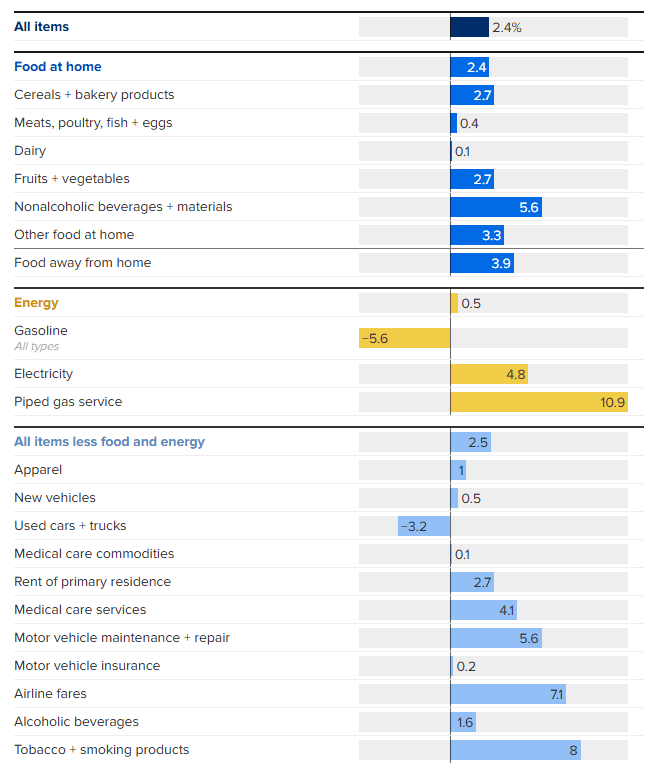
Source: https://www.bls.gov/cpi/
Despite the moderate headline reading, core inflation remains slightly higher at around 2.5%, indicating that certain sectors of the economy continue to experience persistent price pressures.
Core CPI removes volatile categories such as food and energy, making it a key measure used by economists and policymakers to assess underlying inflation trends. Housing costs, particularly rent and shelter-related expenses, remain a significant contributor to the core inflation index.
The relatively small difference between headline inflation and core inflation suggests that price growth across many sectors is stabilizing. However, services inflation continues to show resilience, which could slow the pace at which overall inflation declines.
The U.S. Inflation CPI 2.4% reading therefore reflects an economy where inflation is cooling but still requires careful monitoring.
The U.S. Inflation CPI 2.4% report plays an important role in shaping expectations for future Federal Reserve policy decisions.
The Federal Reserve aims to maintain inflation close to 2% over the long term, while also supporting stable employment and sustainable economic growth. Although the latest CPI report indicates progress toward this goal, policymakers generally prefer to see several months of consistent data before making adjustments to interest rates.
If inflation continues to stabilize near the U.S. Inflation CPI 2.4% level in future reports, financial markets may begin to anticipate potential interest rate cuts later in the year. However, Federal Reserve officials are likely to remain cautious given ongoing uncertainties related to global economic conditions and energy prices.
More information on monetary policy: https://www.federalreserve.gov/monetarypolicy.htm
Financial markets reacted cautiously following the release of the U.S. Inflation CPI 2.4% report. Since the data largely matched economist expectations, market volatility remained relatively limited.
Treasury yields showed modest movement as investors evaluated whether the current inflation trend will continue in the coming months. Meanwhile, equity markets responded with mild optimism, reflecting the possibility that stable inflation could ease pressure on central banks to maintain restrictive monetary policies.
In currency markets, the U.S. dollar experienced moderate fluctuations after the CPI data was released. Inflation reports such as the U.S. Inflation CPI 2.4% update are closely watched because they can directly influence interest rate expectations and global capital flows.
For forex traders, the U.S. Inflation CPI 2.4% report is a critical economic indicator because inflation directly impacts interest rate expectations and currency valuations.
When inflation slows, central banks may consider easing monetary policy or reducing interest rates. Lower interest rates typically reduce demand for a currency as investors look for higher returns elsewhere.
Conversely, stronger inflation readings often support a currency because they may signal tighter monetary policy.
Major currency pairs such as EUR/USD, GBP/USD, and USD/JPY frequently experience increased volatility when CPI data is released.
Following the U.S. Inflation CPI 2.4% release, traders are closely monitoring the U.S. Dollar Index (DXY) to determine the potential direction of the U.S. currency.
Key technical levels include:
If future CPI reports continue to show inflation stabilizing near 2.4%, the U.S. dollar may experience gradual downward pressure. However, stronger economic data or unexpected inflation surprises could provide support for the currency.
While the U.S. Inflation CPI 2.4% report signals improving inflation conditions, the broader economic outlook remains uncertain.
Several factors could influence inflation trends in the coming months, including:
Upcoming economic indicators such as employment data, retail sales figures, and future CPI releases will provide additional insight into whether inflation continues to moderate.
For traders and investors, monitoring these indicators will remain essential for understanding how inflation trends may shape financial markets and monetary policy decisions throughout the year.
Stay informed with FX Axe
If you want to stay ahead of major economic events like the U.S. Inflation CPI 2.4% report, follow FX Axe for:
Learn more: https://fxaxe.com

