

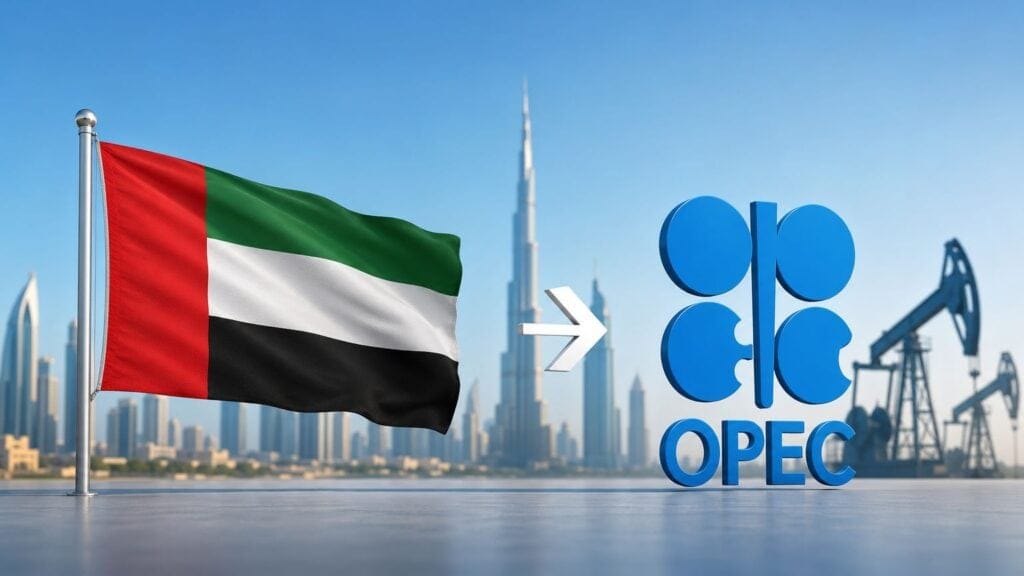
The United Arab Emirates has confirmed that it will officially exit OPEC and OPEC+ coordination frameworks effective May 1, 2026, marking a structural shift in how global oil supply is managed.
This decision ends its participation in quota-based production agreements and signals a transition toward a more independent output strategy. For traders, this is not just a geopolitical headline — it is a shift in how oil markets price coordination and risk.
Crude markets have already started adjusting, with volatility increasing as the effective date approaches.
The UAE's withdrawal move reflects long-standing disagreements within OPEC+ regarding production baselines and output limits.
Over recent years, the UAE has consistently pushed for:
These tensions gradually built a structural gap between UAE production capability and OPEC quota allocations. The exit formalizes that divergence.
OPEC will continue to influence global oil markets. However, its internal structure becomes less cohesive.
Key shifts include:
This does not eliminate OPEC influence — but it changes how markets interpret its signals.
As soon as UAE leaves OPEC becomes effective, the market reaction has been centered on volatility rather than supply shock.
Observed price action includes:
Markets are not pricing a sudden shortage of oil. Instead, they are pricing uncertainty in how supply decisions are coordinated going forward.
The development is being reflected across several key pricing channels:
Traders are assigning lower confidence to unified OPEC+ decision-making.
Global supply buffers are seen as less centralized and predictable.
OPEC guidance is now treated with greater caution.
Oil prices respond faster and more aggressively to news events.
Currencies linked to oil, such as CAD and NOK, show increased sensitivity.
The shift is changing how crude oil behaves on a structural level.
Key behavioural changes include:
Oil markets are transitioning toward a volatility-driven environment, where price action is shaped more by expectations and headlines than steady supply trends.
Know more about OPEC: https://www.opec.org
For traders, the implications are immediate:
In this environment, traders tend to focus more on:
For general inquiries or platform-related questions, you can contact [email protected].
As this news reshapes trading conditions, having the right setup matters more than ever.
These resources are provided for informational purposes only and can help you better understand different trading environments.
The decision of UAE to leave the OPEC marks a structural transition in global oil markets rather than a one-time event.
The core impact is not about supply shortage — it is about reduced coordination certainty.
For traders:
👉 OPEC influence remains relevant
👉 but coordination is less predictable
👉 volatility is becoming a permanent feature
In this environment, the edge shifts from predicting direction to managing volatility and reacting to changing market structure.
Disclaimer: This content is for informational and educational purposes only and does not constitute financial or investment advice.

