

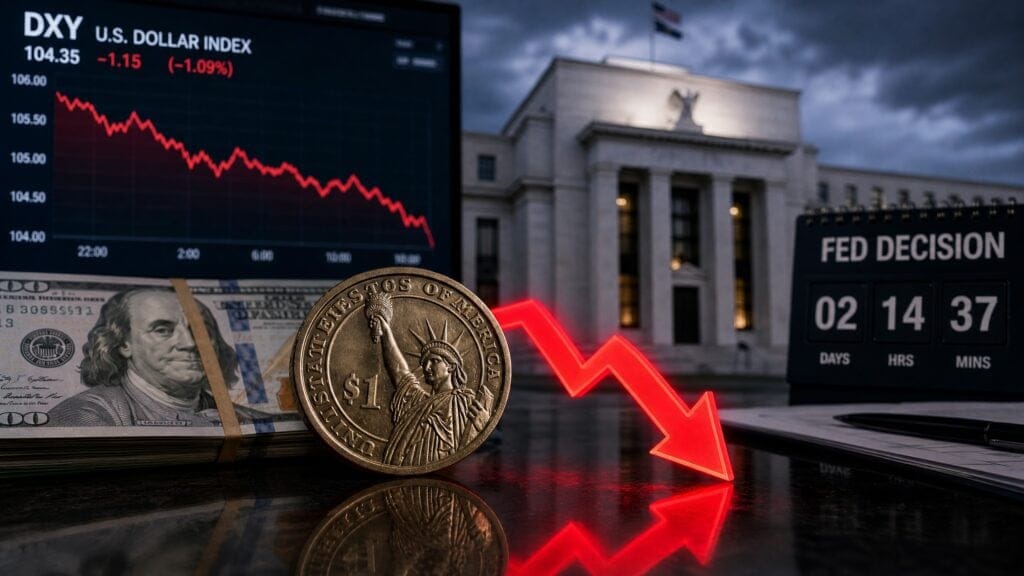
The US Dollar has slipped modestly ahead of today's Federal Reserve policy announcement, leaving many traders wondering what's behind the move. Considering the dollar recently climbed to a one-month high, today's pullback may seem surprising at first glance.
The answer isn't that investors have suddenly turned bearish on the greenback. Instead, the recent weakness reflects a combination of caution, profit-taking, and uncertainty before one of the most closely watched events on the economic calendar.
If you've been asking: why is the US Dollar falling ahead of the Fed decision?
Here are the five biggest reasons driving today's price action.
The biggest reason why is the US Dollar falling ahead of the Fed decision is simple: uncertainty.
The Federal Reserve is due to announce its latest interest rate decision later today, and while markets broadly expect policymakers to leave rates unchanged, confidence isn't absolute. According to market pricing tracked by LSEG, traders still see roughly a 30% chance of a surprise 25-basis-point rate increase, keeping investors cautious ahead of the announcement.
Rather than placing aggressive bets before such a major event, many institutional investors have chosen to reduce exposure and wait for confirmation. That has limited demand for the dollar during today's session.
Another reason Why Is the US Dollar Falling Ahead of the Fed Decision is profit-taking.
Over the past few weeks, the Dollar Index (DXY) recovered strongly and recently reached its highest level in about a month. After a rally like that, it's common for traders to close profitable positions before a high-impact event.
This doesn't necessarily signal a change in the broader trend. Instead, it reflects disciplined risk management.
Reuters reported that the Dollar Index eased back to around 101.33 after touching 101.63, while the euro recovered slightly toward 1.1395 against the dollar.
Anyone asking why is the US Dollar falling ahead of the Fed decision also needs to understand how markets price expectations.
Most economists still expect the Fed to leave interest rates unchanged at today's meeting. Since that outcome is already largely priced into financial markets, traders are paying much closer attention to the Fed's statement and Chair Kevin Warsh's press conference than the rate decision itself.
If policymakers suggest inflation risks remain elevated or hint that further tightening is still possible, the dollar could quickly regain strength.
On the other hand, if the Fed signals growing confidence that inflation is easing, markets may interpret the statement as slightly dovish, putting additional pressure on the dollar.
At first glance, geopolitical tensions would normally support the US Dollar.
Recent developments in the Middle East have increased demand for defensive assets, but investors aren't buying only dollars. Gold and the Japanese yen have also attracted safe-haven flows as traders look to diversify risk ahead of today's Fed decision.
That's another important reason why is the US Dollar falling ahead of the Fed decision despite ongoing geopolitical uncertainty.
In other words, the dollar is still benefiting from its safe-haven status, but it's sharing that demand with other traditional defensive assets.
Professional traders know that some of the biggest market moves happen after the Fed speaks, not before.
That's why many investors prefer to stay on the sidelines until they hear both the policy decision and the central bank's outlook for inflation, growth, and future interest rates.
This "wait-and-see" approach often reduces trading activity before major announcements, which can temporarily weigh on the dollar.
So if you're still wondering why is the US Dollar falling ahead of the Fed decision, today's softer trading conditions are a reflection of patience rather than panic.
Today's Fed meeting could set the tone for currency markets over the coming weeks.
If the Fed sounds more hawkish than expected, the US Dollar could recover quickly, putting pressure on currency pairs such as EUR/USD and GBP/USD, while lifting the Dollar Index.
However, if policymakers appear more comfortable with the recent inflation trend or signal that rates are likely to stay on hold for longer, the dollar may extend today's decline.
Traders should also watch USD/JPY, which remains near multi-decade highs despite today's modest yen recovery. Japanese officials have continued monitoring currency movements closely, meaning any sharp post-Fed rally could revive speculation about intervention.
Gold is another market likely to experience increased volatility once the Fed decision is released.
So, why is the US Dollar falling ahead of the Fed decision?
The answer isn't one single headline. Today's move reflects several factors coming together: investors are taking profits after the dollar's recent rally, reducing risk before a major central bank announcement, and waiting to see whether the Federal Reserve changes its outlook for interest rates.
The good news for traders is that the biggest move may still be ahead.
Once the Fed releases its decision and Chair Kevin Warsh begins his press conference, markets will have much clearer direction. Until then, today's softer dollar looks more like cautious positioning than a sign of a major trend reversal.
Visit FX Axe for the latest educational guides, trusted broker comparisons, and daily market updates. You can also follow our YouTube channel for easy-to-understand forex news, trading explainers, and weekly market insights.
Many traders are reducing their exposure ahead of the Federal Reserve meeting. Profit-taking, uncertainty, and expectations that rates will remain unchanged have all contributed to the dollar's recent weakness.
Most economists expect the Federal Reserve to keep interest rates unchanged. However, traders are paying closer attention to the Fed's statement and press conference for clues about future policy.
The biggest moves are likely to be seen in:
Gold (XAU/USD) is also expected to react sharply after the announcement.
The Federal Reserve influences interest rates, inflation expectations, and capital flows. Changes in monetary policy can strengthen or weaken the US Dollar, affecting nearly every major currency pair.

