

Exactly a week today, on 3 November, Americans are going to vote in an election in which Donald Trump is not standing, nobody is electing a president and yet the result could fundamentally alter the remaining two years of Donald Trump's presidency. Welcome to the US midterms, an electoral system that everybody in America appears to understand instinctively and everybody outside America nods along to while quietly wondering what the hell a congressional district is.
So, before we get into predictions, swing states, polling models and who is going to win what, I thought it might be useful to do something much simpler: what actually are the midterms, what is being elected, why does it matter, and what happens to Trump depending on who wins?
This is deliberately not my prediction piece. We'll do that closer to 3 November, when the final polling is in and we can look properly at the races that will decide control of Washington. At the moment, national polling looks distinctly uncomfortable for Republicans. A recent Reuters/Ipsos poll put Trump's approval rating at 31 per cent and gave Democrats a 47–35 lead among registered voters when asked which party's congressional candidate they would support. But national polling in American congressional elections is a bit like knowing the average rainfall across Africa when deciding whether you need an umbrella in Durban. Interesting, certainly, but it doesn't necessarily tell you what's happening where you actually are.
For today, then, no crystal ball. This is simply the idiot's guide to what America is actually about to do.
[Everything from “First things first: Trump isn't up for election” through to the final section remains exactly as in the previous version.]
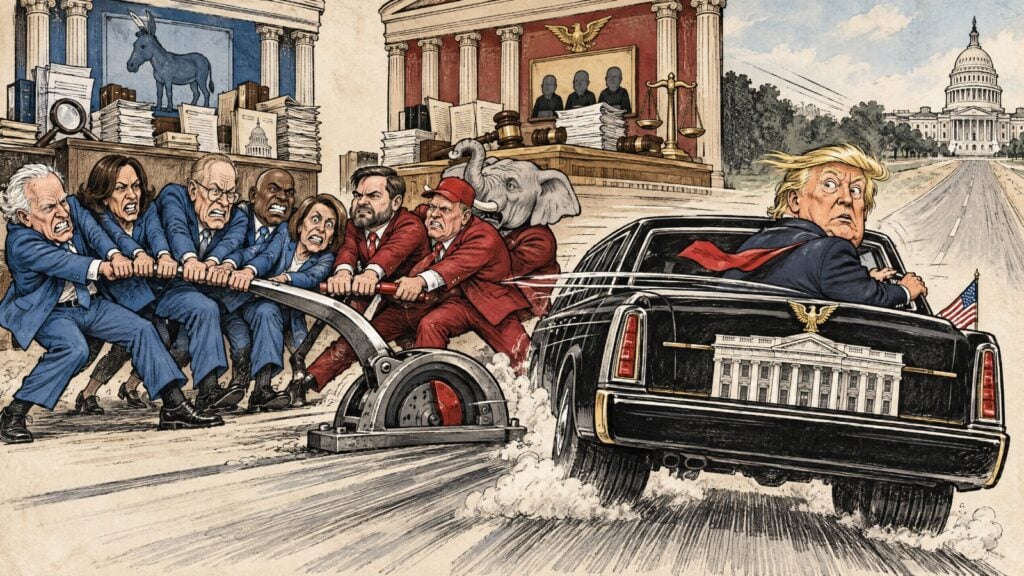
This is the simplest way I can explain it.
They are not deciding whether Donald Trump remains President. They are deciding what sort of presidency Donald Trump has for his final two years.
A Republican sweep gives him the clearest runway: friendly committees, easier appointments and the best opportunity to continue legislating. A Democratic House gives him an investigator sitting across the table, armed with subpoenas, while a Republican Senate can continue approving appointments. A Democratic Senate gives the opposition enormous influence over judges and senior officials. A Democratic sweep puts congressional power firmly in opposition hands, creating investigations, legislative gridlock and much tougher negotiations over spending, while still leaving Trump with the presidency, the veto and substantial executive authority.
That is what is actually at stake on 3 November. The current polling suggests Democrats have momentum. Reuters/Ipsos recently gave them that substantial national congressional-ballot lead, and most analysis currently makes them favourites to take the House. The Senate is a considerably tougher proposition and remains much less certain. Republican redistricting has also made the House harder for Democrats than the national polling alone would suggest.
But I'm deliberately stopping there today. Closer to polling day we'll do the proper Max's Daily Chop election special: which races actually matter, where the probabilities sit, what the polling says, what I think the realistic scenarios are and, crucially for us, what each result could mean for the dollar, equities, bonds, gold, oil and the broader Trump economic agenda.
For now, the important thing is simply to understand the machinery. Because on 3 November Americans aren't choosing a new driver. They're deciding who gets control of the brakes.
Keep your Axe sharp. We'll do the numbers next.
Max
Join the FX Axe newsletter and stay one chop ahead.

