

The Japanese yen gained fresh momentum on Friday as USD/JPY drops below 160.00 following a brief rebound after the Bank of Japan’s latest monetary policy decision. The move came after the BOJ kept its interest rate unchanged at 1.0%, leaving markets focused on the central bank’s future policy direction and the ongoing strength of the yen.
The latest move in USD/JPY shows that traders were looking beyond the rate decision itself. While the BOJ did not deliver a surprise change, expectations around future rate adjustments, inflation trends, and currency intervention risks continued to influence market sentiment.
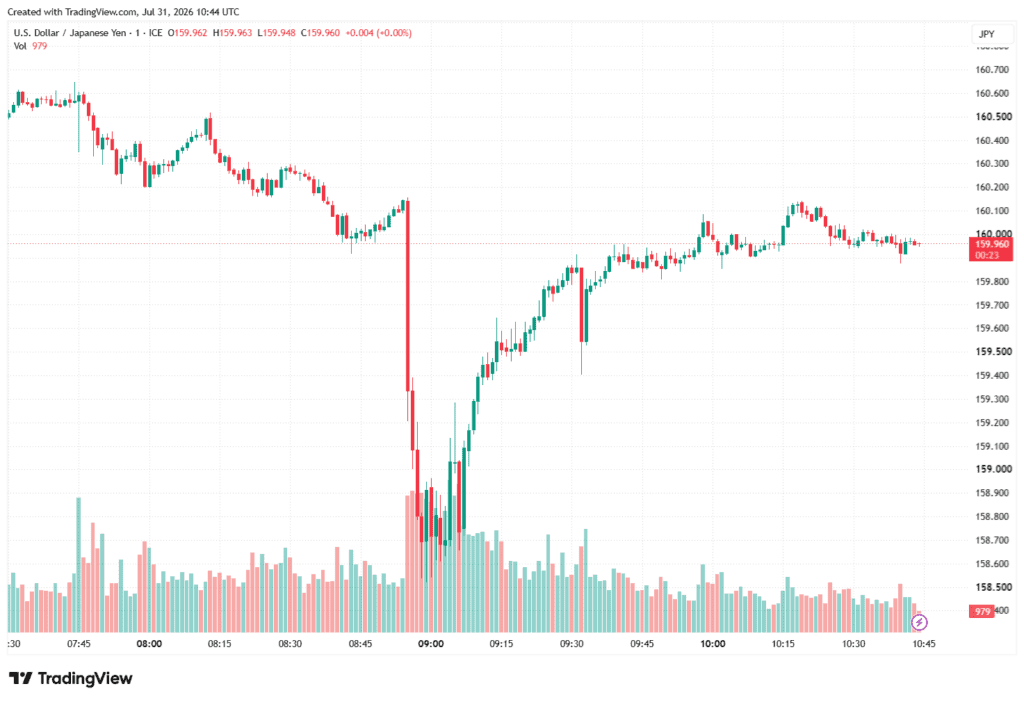
The Bank of Japan maintained its policy rate at 1.0% during its latest meeting, continuing its gradual approach toward normalizing monetary policy.
The decision reflected the BOJ’s cautious stance as policymakers assess Japan’s economic recovery, wage growth, and inflation stability. Unlike some major central banks that moved aggressively in recent years, the BOJ has taken a slower path due to Japan’s long period of low inflation.
Following the announcement, USD/JPY drops below 160.00 as investors adjusted their expectations around the Japanese yen.
The market reaction showed that traders were paying close attention not only to the current interest rate but also to signals about future policy moves.
Learn more about: How Interest Rates Affect The Forex Market

The decline came after a short-lived rebound in the pair. Initially, USD/JPY attempted to recover following the BOJ announcement, but the move quickly lost momentum.
As USD/JPY drops below 160.00, the pair returns to a key psychological level that has attracted significant attention from forex markets.
The yen’s recovery was supported by several factors, including renewed demand for Japanese currency assets and continued speculation about possible action from Japanese authorities if currency movements become too rapid.
The 160.00 level has remained closely watched because previous moves toward this area increased concerns about potential government intervention.
The US dollar has also played a role in the recent movement.
USD/JPY is heavily influenced by the difference between US and Japanese interest rates. When expectations around Federal Reserve policy change, the impact is often reflected across major dollar pairs.
Recent shifts in US rate expectations have reduced some support for the dollar, creating additional pressure on the pair.
The combination of softer dollar momentum and renewed yen demand helped push USD/JPY lower, with USD/JPY drops below 160.00 becoming one of the biggest forex market stories of the day.
Although USD/JPY is receiving the most attention, other yen-related pairs are also being monitored.
Currency pairs traders are watching include:
A stronger yen can create broader movements across these pairs, making Japanese currency developments important for the wider forex market.
After the BOJ decision, attention will shift toward upcoming economic data and central bank comments.
Markets will continue following:
The next direction for USD/JPY will likely depend on how investors interpret these developments.
For now, USD/JPY drops below 160.00 remains the key market theme as traders evaluate whether the yen’s recent strength can continue.
The latest move shows that central bank decisions are not only about the current interest rate. Market expectations, future policy guidance, and currency sentiment often create the strongest reactions.
The fact that USD/JPY drops below 160.00 despite the BOJ keeping rates unchanged at 1.0% shows that traders are focused on the broader outlook rather than just the immediate announcement.
With the yen remaining highly sensitive to policy expectations and intervention risks, USD/JPY will continue to be one of the most closely watched forex pairs.
For more forex news, broker reviews, and trading education, visit the FX Axe YouTube channel.

