


The Japanese yen is back under pressure as USD/JPY moves towards the psychologically important 160 level, reviving concerns that Japanese authorities could intervene again to support the currency.
On Tuesday, August 11, USD/JPY dipped to around 159.30 yen per dollar, after the yen suffered its sharpest one-day decline in almost five months during the previous session.
The renewed weakness comes only days after a historic U.S.-Japan intervention helped strengthen the yen dramatically. The episode has left traders particularly sensitive to further moves around the 160 area, making USD/JPY one of the most closely watched currency pairs in global markets today.
The latest move shows how quickly the impact of intervention can fade. Before the recent operation, the yen had weakened to a 40-year low of 163.99 per dollar. Following the intervention, USD/JPY fell sharply, eventually reaching 155.20, giving the yen a substantial short-term boost.
That recovery has now partially unwound. On Monday, the yen weakened 0.84% against the dollar to 159.14, its biggest daily decline in almost five months. On Tuesday, USD/JPY remained close to 159.30 as traders assessed whether the intervention effect was losing momentum.
The speed of the reversal is important because another sustained move towards 160 could increase pressure on Japanese officials to respond.
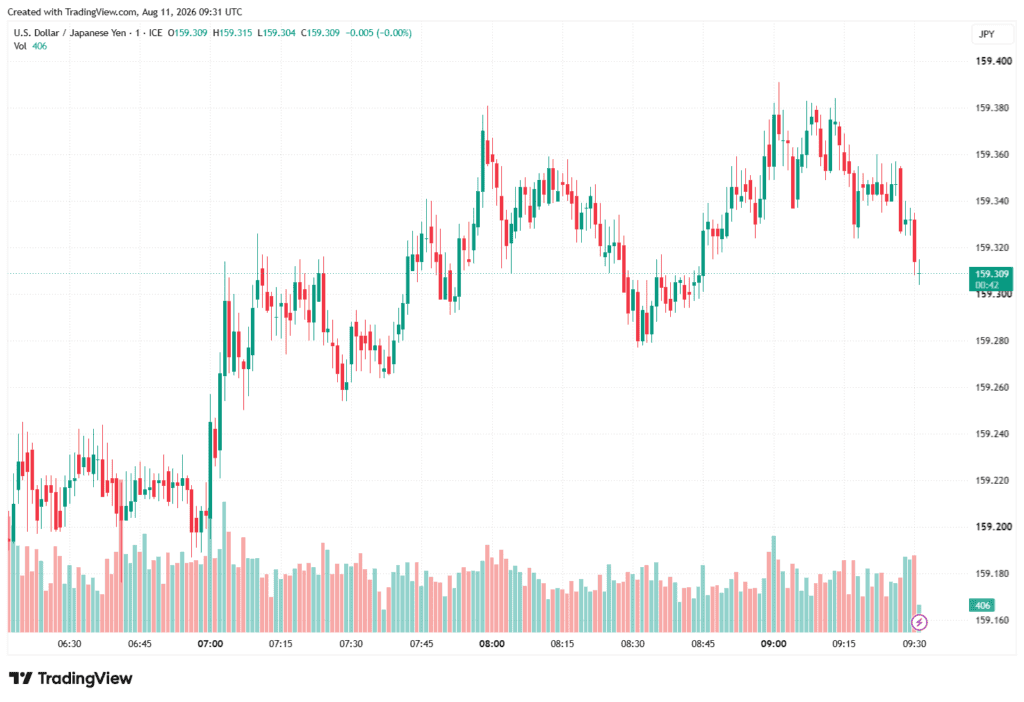
The 160 level has become a major psychological threshold for USD/JPY. Although Japanese officials do not publicly announce a specific intervention level, the area has historically attracted intense market attention when yen weakness becomes rapid or disorderly.
The approach towards 160 means traders are now watching USD/JPY for signs of another official response. A sustained move above the level could reinforce the dollar's momentum, while a sudden reversal could signal intervention fears are dominating trading.
The timing is also significant because Japan is entering its Obon holiday period. Reuters reported that thinner market liquidity during the holiday could amplify currency moves, meaning relatively modest trading flows could potentially produce larger swings in USD/JPY.
Another important development is the reduction in speculative bearish positioning against the yen.
Reuters reported that speculative net short yen positions dropped by $8.865 billion to $3.604 billion in the week ending August 4. The reduction followed the recent intervention and represented the largest weekly decline in bearish yen positioning in more than 12 years.
That shift suggests traders are becoming more cautious about aggressively betting against the Japanese currency. For USD/JPY, this matters because crowded yen-short positions can be vulnerable to sharp reversals if Japanese authorities intervene or U.S. economic data weakens.
However, the reduction in short positions does not necessarily mean the yen's broader weakness has ended. If Japanese monetary policy remains relatively accommodative or the dollar receives support from stronger U.S. data, traders could rebuild bearish yen positions.
While intervention remains the immediate concern, U.S. inflation is likely to be the next major driver for USD/JPY.
Markets are preparing for the July U.S. Consumer Price Index report due Wednesday, August 12. The data could have a major influence on expectations for Federal Reserve policy and, consequently, the direction of the dollar.
The U.S. jobs market has recently complicated the Fed outlook. July payrolls unexpectedly declined by 23,000, increasing speculation that the Federal Reserve could face greater pressure to ease policy. Reuters reported that money markets were pricing roughly a 52% chance of a September Fed rate hike on Monday, down from 67% a week earlier.
A hotter-than-expected CPI reading could support the dollar by reinforcing expectations for higher U.S. rates, potentially pushing USD/JPY closer to or above 160. Conversely, softer inflation could weaken the dollar and give the yen additional breathing room.
Energy markets are also becoming increasingly important for the dollar outlook. Brent crude has risen around 5% over the past two sessions and was trading near $88 a barrel on Tuesday, its highest level since July 31. The increase follows stalled U.S.-Iran negotiations and uncertainty surrounding the reopening of the Strait of Hormuz.
Higher oil prices could add to inflation concerns in the United States, making the CPI report even more significant for USD/JPY and broader financial markets.
The immediate focus for USD/JPY is whether the pair can challenge 160.00 without triggering another sharp reaction from Japanese authorities.
A sustained move above 160 would put the yen under renewed pressure and could attract further intervention speculation. On the other hand, a rejection near 160 followed by a move back below 159 could indicate that intervention concerns and positioning risks are limiting the pair's upside.
For now, USD/JPY sits at the intersection of two powerful market forces: changing Federal Reserve expectations and Japanese efforts to prevent excessive yen weakness.
With U.S. CPI due tomorrow and the pair approaching 160 again, USD/JPY is likely to remain one of the most important currency markets to watch. The key question is no longer simply whether the yen can recover, but whether Japanese authorities will tolerate another sustained move towards 160.
For USD/JPY, the next few sessions could therefore be critical. A stronger-than-expected U.S. inflation reading could provide another boost to the dollar, while softer data or renewed Japanese action could send the pair sharply lower.
Stay updated with FX Axe for daily forex news, market analysis, broker reviews, and trading education.
Watch FX Axe on YouTube.

