

Bear with me on this one. Those of you who watch the FX Axe videos may have gathered that I'm rather fond of cricket. I have been since I was old enough to get bowled out embarrassingly, trudge back towards a pavilion and begin the lifelong process of explaining why what had just happened wasn't entirely my fault.
For our readers in Britain, Australia, Pakistan, India, South Africa and large parts of the UAE, none of what follows will seem particularly strange. For our American, Canadian or rest of the non-cricketing world of readers, I appreciate I'm about to discuss a sport that can last five days, stops for lunch and tea, and sometimes ends without anybody winning. But stay with me, because if you're interested in trading, you may already possess precisely the sort of brain required to become dangerously interested in cricket. Both involve enormous quantities of data, endless competing theories, people confidently predicting things they cannot possibly know and grown adults spending entire afternoons staring at tiny movements on a screen. Sound familiar?
Cricket must be among the most statistically obsessed sports humanity has devised. Take a batsman walking to the crease in a Test match. We don't simply know whether he's "good". We know his career average, his average this year, his average at home and away, his record in Australia, England, India and Pakistan, his record against left-arm pace, right-arm pace and spin. We can establish how he performs against the short ball, the moving ball, on flat pitches, green pitches, turning pitches and probably pitches where somebody in Row 14 is wearing an unusually distracting hat.
Modern analysts can map where every ball was delivered and what happened to it, and databases such as ESPNcricinfo's Statsguru allow international careers to be pulled apart by opposition, location, series and individual innings. Trading isn't enormously different. Before taking a position, you can study historical prices, volatility, moving averages, correlations, support levels, central-bank policy, employment data, inflation, positioning and sentiment. You can build algorithms, backtest strategies and study what happened the previous hundred times apparently similar conditions occurred.
And after all of that, the market can take one look at your beautiful analysis and do something completely different.
Cricket does this constantly.
A bowler can spend an entire over setting up a batsman. Short ball, short ball, something just outside off stump. Move the field, alter the angle, convince the batsman another short one is coming, then produce the perfect full delivery designed to take the edge. Except the batsman somehow gets half a bat on it, the ball flies between two fielders and disappears for four.
Was the strategy wrong? No. Was the execution wrong? No. Did you lose that particular outcome? Absolutely. And that distinction is enormously important in trading because a good decision can produce a bad result, just as a bad decision can produce a good one.
You can buy because your analysis is excellent and still lose money. You can also drunkenly buy something because a man called CryptoWizard69 mentioned it on X and make 30%. Neither result, in isolation, tells you whether the process was sensible. You discover that over time, which brings us neatly to averages.
Harry Brook, the current Test Match world number 1 batsman, is a particularly interesting example. There are moments when watching Brook bat when you think you're witnessing one of the finest players of his generation, and there are other moments when he gets himself out playing a shot of such unnecessary ambition that you briefly wonder whether somebody has offered him dinner reservations if he gets back to the dressing room before six.
That creates a perception: brilliant, reckless, gives his wicket away. Except the numbers keep being rather awkward for that argument.
Going into this Pakistan series, Brook has a Test batting average of around 53 after 38 Tests. That's currently higher than Brian Lara's completed career average of 52.88 and Ricky Ponting's 51.85. Against Pakistan specifically, Brook averages around 84, including four centuries and that extraordinary 317 at Multan. (The Times).
Nobody sensible is claiming 38 Tests makes Brook greater than Brian Lara. Lara did it across 131 Tests, different opponents, different conditions and an entire career of teams desperately trying to work out how to get him out. And that's precisely the point. The headline number matters, but so does the sample, and so do the conditions underneath the number.
It's exactly the same mistake traders make when they find a strategy that returned 40% last year and immediately conclude they've discovered capitalism's cheat code. Over what period? In what conditions? With what drawdown? How did it perform when volatility changed, and what happens when the market stops behaving in the way that made the strategy successful?
An average is incredibly useful. It isn't magic.
England fast bowler Ollie Robinson is an even more interesting example because perception and statistics have spent much of his international career having an argument. Robinson doesn't look like the archetypal modern fast bowler. He isn't thundering in like a malfunctioning combine harvester at 95mph. His fitness has been questioned, his pace has been questioned and his durability has been questioned.
Yet, coming into today's Test, his career record stood at 83 wickets at 21.92 apiece. (MyKhel) For the non-cricket readers still gamely hanging on at this point: that's very good. And today, recalled for England against Pakistan at Headingley, Robinson took a wicket with the first ball of the series. (The Guardian)
Sometimes the thing that doesn't look right works, and trading is full of this. There will always be a strategy that looks more sophisticated than yours. Somebody will have twelve monitors, seventeen indicators and a chart resembling the flight-control system of a moderately advanced spacecraft. But if your boring system keeps producing results, perhaps boring isn't a problem.
Then there are the things statistics haven't spotted yet. Steve Smith made his Test debut for Australia in 2010 primarily as a leg-spinning all-rounder, batting down the order. He was talented, certainly, but nobody watching those early appearances was necessarily looking at the future owner of one of the great batting records of the modern era. Even ESPNcricinfo's statistical record still rather charmingly lists him as a right-hand batsman and "legbreak googly" bowler. (ESPNcricinfo)
Players change and markets change. Something that doesn't work today can work tomorrow because the underlying conditions have altered, while something that has worked beautifully for five years can suddenly stop. That's why blindly following historical performance is dangerous, whether you're selecting an opening batsman or an FX strategy.
And then, occasionally, sport produces something that makes the whole argument for you.
A few weeks ago, Bangladesh were beaten by Zimbabwe by an innings and 85 runs. They also lost the first two ODIs of that tour. Before their Australian Test series, they played a warm-up match and were bowled out for 54 in their second innings. (Bangladesh Sangbad Sangstha)
Then they walked into a Test match against Australia, in Australia. Australia were the World Test Championship pacesetters, while Bangladesh had never won a Test on Australian soil. Bangladesh won by nine wickets. Not scraped it through a bit of luck or watched the rain intervene at precisely the right moment: nine wickets. Hasan Mahmud took six wickets in Australia's first innings, Bangladesh made 426 and Australia were comprehensively outplayed, with captain Pat Cummins saying as much afterwards. (ICC)
If sport behaved exactly as historical probability suggested it should, there would be very little reason to watch it. And if markets behaved exactly as our models predicted, there would be very little money to make from trading them.
This is perhaps where cricket and trading overlap most interestingly. Some cricketers are intensely analytical. They study footage, match-ups, release points, field positions and probabilities. Others appear to operate partly on instinct. Trading has the same divide. Some traders want the numbers, while others watch price action for long enough that they develop something approaching intuition. They cannot always articulate every variable behind a decision; they've simply seen versions of the pattern before.
Neither approach is automatically superior, but there's an important caveat. What we call "feel" in an experienced professional is often thousands of hours of pattern recognition masquerading as instinct. Joe Root doesn't need somebody to hand him a spreadsheet before every delivery. Decades of cricket have trained his brain to process information almost instantaneously. The experienced trader can develop something similar.
The dangerous bit is confusing intuition developed through experience with having a hunch. They are very different things, even if both can feel remarkably convincing at the time.
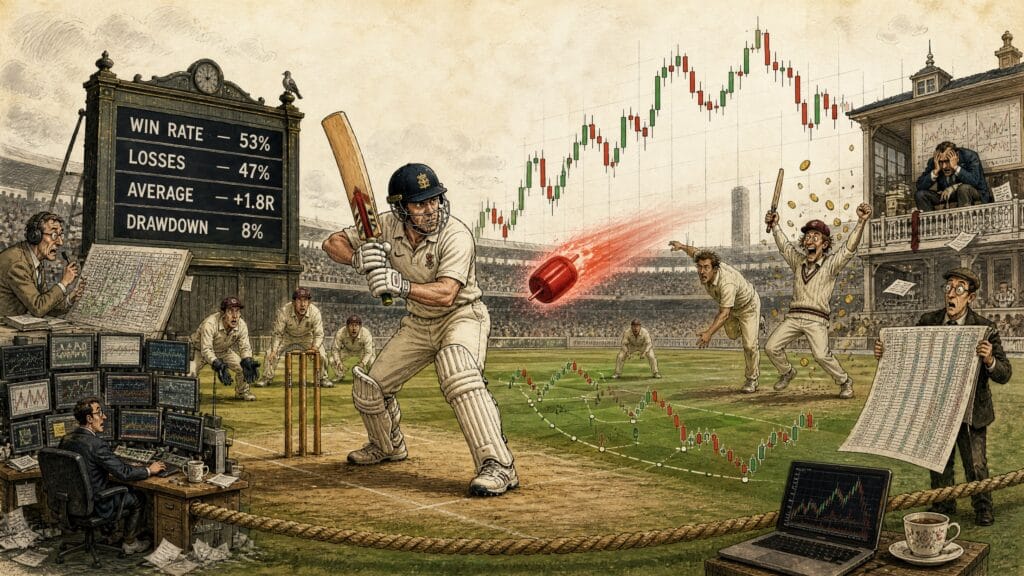
And perhaps that's the real lesson. Joe Root (England’s Test run record scorer) and Harry Brook can both score enormous numbers of Test runs without batting remotely alike. A fast bowler doesn't need to become a spinner because spin happens to be working this week, and Bangladesh shouldn't attempt to become Australia in order to beat Australia. They need to understand what they do well and create conditions in which those strengths matter.
Trading is much the same. You don't need somebody else's strategy. You need a strategy that suits your temperament, your risk tolerance, your timeframe and the markets you actually understand, and then you need enough discipline to keep following it when somebody else's approach temporarily looks much cleverer.
Because individual trades are deliveries. A good one can disappear for four and a terrible one can take a wicket. What matters is what happens over the spell, the innings, the match and eventually the career. That's why cricket has averages, and it's why traders should too.
So if you've never understood cricket, perhaps give it another chance. Behind the whites, tea breaks and incomprehensible vocabulary is essentially a five-day experiment in probability, psychology, risk management and human beings refusing to behave as the spreadsheet says they should.
And if you already love cricket, you'll probably understand why trading feels strangely familiar. You prepare, study the conditions, play the percentages and accept that occasionally Bangladesh will beat Australia by nine wickets. Then you come back tomorrow and do it all again.
Stick to your game. Trust your average. Manage the bad innings.
And, naturally, keep your Axe sharp.
Max
Want more of The Daily Chop?
Sharp market stories, trading takes and financial madness straight to your inbox.

