

We are approaching one of the great traditions of the English football season. The leaves are falling, the clocks are changing, Christmas decorations are appearing approximately six weeks before anybody wants them, and Premier League football managers are beginning to look nervously at their phones. Welcome to sacking season. At the top of this year's queue is Michael Carrick. Manchester United were beaten 3–0 at home by Bournemouth on Sunday, extending their winless run to eight matches in all competitions. They have won only two of their first 12 games this season, sit 16th in the Premier League and have made their worst start to a league campaign in 40 years. A few days earlier they had been dismantled 4–1 by Como in the Champions League. Carrick is now the odds-on favourite to be the next Premier League manager to leave his job, while United's hierarchy are reportedly holding crisis talks over whether to sack him. It isn't going terribly well.
As I think I've made explicitly clear before, football is not my favourite sport in the world. I enjoyed it when I was younger, then eventually discovered cricket, rugby, golf and the pleasures of watching sports where somebody can be lightly brushed on the shoulder without immediately rolling around on the floor clutching their face. But from a business perspective, football is absolutely fascinating, and nowhere more so than in the way it treats managers. There are very few other industries where an organisation can spend hundreds of millions assembling a workforce, employ armies of executives responsible for recruitment, finance, operations, strategy and performance, watch the entire organisation underperform, and then decide that the solution is to fire one bloke standing beside the pitch. Manchester United might be the greatest example of all.
I grew up in the 1990s, which meant Manchester United weren't merely a football club. They were everywhere. Eric Cantona with the collar turned up, Peter Schmeichel looking approximately nine feet tall in goal, Roy Keane terrifying everybody, Ryan Giggs running down the wing, Paul Scholes, David Beckham, Andy Cole, Dwight Yorke, Teddy Sheringham, Mark Hughes earlier in the decade, Steve Bruce, Denis Irwin and Gary Pallister. Then the extraordinary Class of '92 generation emerged at precisely the moment United were becoming the dominant force in English football. I have deliberately omitted the Nevilles because I don't like them.
United won six of the first eight Premier League titles and finished the decade with the 1999 Treble: Premier League, FA Cup and Champions League. Their own history describes the 1990s as the decade in which the club ended up “on top of the world”, and that's barely exaggeration. Manchester United's combination of success, star players and aggressive commercial expansion turned it into one of the most recognisable sporting brands on Earth. Old Trafford was the Theatre of Dreams, and if you were a child watching football in Britain in the 1990s, Manchester United felt less like a football team than one of the permanent institutions of the country. Governments changed. James Bond changed. The Sugababes changed members with alarming regularity. Manchester United won the league. Manchester United's history of the 1990s
The extraordinary thing is that this was all built around managerial continuity. Alex Ferguson arrived in 1986 and remained for nearly 27 years. More importantly for today's story, he very nearly didn't. By the beginning of 1990, after several difficult seasons, there was enormous pressure on Ferguson and persistent speculation that he could lose his job. United won the FA Cup that year, and what followed became the most successful managerial reign in British football history. Imagine applying modern football logic to that story: poor run of results, fans unhappy, manager under pressure, sack him, bring somebody new in, enjoy the new-manager bounce, announce a new philosophy, buy some new players and repeat eighteen months later. Manchester United might have fired Sir Alex Ferguson before Sir Alex Ferguson existed.
Since Ferguson retired in 2013, Manchester United have spent more than a decade attempting to recreate what they had and discovering that apparently it wasn't quite as simple as hiring another manager. David Moyes came and went. Louis van Gaal came and went. José Mourinho came and went. Ole Gunnar Solskjær came and went. Erik ten Hag came and went. Ruben Amorim came and went. Interims and caretakers filled the gaps, including Carrick himself before eventually returning and earning the permanent job after an excellent interim spell last season.
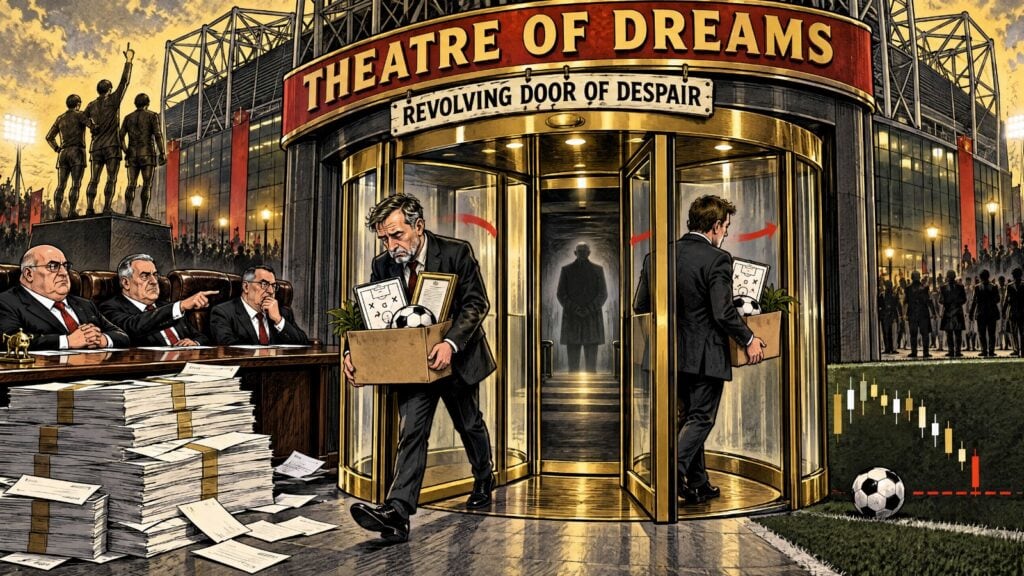
And now, four months after signing a two-year contract as permanent head coach, Carrick may be going as well. He took over on an interim basis in January, won 12 of 17 matches, took United to third and into the Champions League, and was rewarded with the permanent job in May. A few months later, after two wins from 12 matches and an eight-game winless run, he is the overwhelming favourite for the sack. That's not the Theatre of Dreams. It's becoming the Revolving Door of Despair.
The really remarkable part is what all this has cost. Sky calculated earlier this year that United's payouts to dismissed managers, coaches and other senior staff since 2014 were approaching £100 million. The club confirmed that dismissing Ruben Amorim alone could cost almost £16 million, after it had already paid £11 million to prise him and his staff away from Sporting and £10.4 million to remove Erik ten Hag and his staff. The combined cost associated with those two managerial changes could reach £37.3 million. Thirty-seven million pounds to change the bloke standing in the technical area twice. At some point, this stops looking like a solution and starts looking like a subscription service. Sky News on Manchester United's managerial payouts
This is the part I find fascinating from a business perspective. Imagine Manchester United were not a football club but an enormous multinational company. It hires a chief executive on a lucrative multi-year contract. The CEO introduces a new strategy, restructures departments, hires people suited to that strategy and begins changing the organisation. Eight months later the numbers look poor, customers complain and the board fires him. It then pays him millions of pounds to leave, pays another organisation millions to release its preferred replacement, hires that person on another multi-year contract and begins changing the organisation again.
The new CEO has a different strategy, so the company hires different people and changes the operating model. Results don't improve quickly enough, so he goes as well. Compensation, new CEO, new philosophy, new staff, new strategy. If a listed company did that repeatedly for thirteen years, shareholders might eventually begin wondering whether the CEO was the problem or the board selecting the CEOs was the problem.
Football is different, of course. Results arrive brutally and publicly every weekend. There is no hiding behind a five-year strategic plan when Bournemouth have just beaten you 3–0 in front of 70,000 furious customers. Relegation can destroy revenues. Missing the Champions League can cost tens of millions. Players can lose confidence in a manager and, once a dressing room stops responding, recovery can be extremely difficult. Sometimes changing the manager genuinely works. But football also has one enormous incentive that conventional businesses don't: changing the manager is the quickest visible thing an owner can do.
You cannot replace fifteen players on Monday morning. You cannot rebuild the academy by Wednesday. You cannot fix recruitment before Saturday. You cannot create a coherent footballing culture during the international break, and you cannot magically turn an ageing £70 million midfielder into the player you thought you had bought. But you can sack the manager, and suddenly you've done something.
From a trading perspective, the football manager is basically the ultimate stop-loss. The position is moving against you, the crowd is getting nervous and the board doesn't know whether the underlying thesis is broken or whether you're simply experiencing temporary volatility. Eventually somebody decides the pain has become intolerable and presses close. Sometimes that's exactly the correct decision. One of the most dangerous mistakes in trading is refusing to admit that your thesis was wrong. “Give it time” can be sensible patience, but it can also be what people say while an objectively terrible position continues losing money.
The difficulty is distinguishing a bad strategy from normal variance, and Carrick is an almost perfect example. Last season the evidence said he was doing an excellent job: 12 wins from 17 matches, third place, Champions League qualification. United looked at those results and concluded that he deserved the permanent position. Four months later, another sample of results says almost precisely the opposite. Which Carrick is real? Perhaps both are. Football contains injuries, confidence, fixtures, transfers, dressing-room politics, individual mistakes and plain old luck. A manager can make the correct tactical decision and watch his centre-back pass the ball directly to an opposition striker. In business terms, imagine if your quarterly results depended partly on Dave from accounts unexpectedly kicking the balance sheet into his own net.
There is also a wonderfully strange economic incentive built into football management: getting sacked can be extremely lucrative. Most of us approach redundancy with a certain degree of trepidation. Football managers occasionally approach it with several years remaining on a contract worth millions of pounds.
Sam Allardyce is one of my favourite examples, not because he deliberately tried to get himself fired — there is no evidence of that — but because his career illustrates the extraordinary economics of the profession. Newcastle appointed him on a three-year contract in May 2007. Eight months later they sacked him with roughly two and a half years remaining, with contemporary reports putting his compensation in the millions. Big Sam then did something magnificent with the money: he bought a Spanish villa and reportedly named it Casa St James. The Irish Times on Allardyce and Casa St James
That is outstanding. Imagine being fired by Barclays, buying a villa in Marbella with the redundancy money and calling it Casa Barclays. Allardyce subsequently developed almost a specialist reputation for being parachuted into troubled clubs: Blackburn, West Ham, Sunderland, Crystal Palace, Everton and eventually Leeds. He became football's emergency plumber. The club is leaking goals, relegation is approaching and nobody knows what to do, so break glass and call Big Sam. Sometimes it worked extremely well; he had a particularly strong record stabilising struggling teams. But it also demonstrates the peculiar market football has created. Managers can be hired for enormous salaries, fired while still owed enormous salaries and then hired somewhere else to repeat the process. The risk-reward profile isn't terrible.
The bigger business lesson, though, is about confusing a visible problem with a root cause. Managers are visible. Recruitment departments aren't. Ownership structures aren't. Sporting directors aren't. Data departments aren't. Long-term capital allocation isn't. A manager stands in front of the cameras three times a week and explains why eleven highly paid adults have once again forgotten how marking works, so when things go wrong he becomes the face of failure.
Manchester United's post-Ferguson history increasingly suggests that the manager cannot possibly be the entire explanation. United have tried the chosen successor in Moyes, the decorated European veteran in Van Gaal, the serial winner in Mourinho, the beloved former player in Solskjær, the tactical moderniser in Ten Hag, the fashionable young coach in Amorim and now another former player in Carrick. Different ages, different personalities, different tactics and different CVs, but the same club. At some point, if you have changed the manager repeatedly and the broad problem keeps returning, you have to consider the possibility that the manager isn't the common denominator. Manchester United is.
There are absolutely times when the answer is now. If the manager has lost the dressing room, if his strategy is obviously failing, if the players no longer believe in him, if performance metrics are deteriorating beyond what results alone show, or if keeping him risks relegation or some other catastrophic financial outcome, delaying because you want to appear patient can be just as foolish as panicking.
Business has the same problem. There is no virtue in keeping a terrible chief executive for another three years simply because you once described the appointment as a “long-term strategy”. Sunk-cost fallacy works in both directions. The millions you spent hiring somebody are gone whether you keep them or sack them. The question is whether changing the person actually changes the underlying system.
That is where football clubs often seem remarkably bad at diagnosis. They identify the manager as the failing asset without asking whether they gave him the right players, whether recruitment matched his strategy, whether the executive structure works, whether incentives are aligned or whether the organisation has any coherent idea what it wants to be. If your restaurant has terrible ingredients, a broken oven, an incompetent purchasing department and three owners arguing about the menu, changing the chef every eighteen months may not get you a Michelin star. Eventually you need to look at the restaurant.
Manchester United also suffers from something particularly difficult: its own history. Every manager walks into Old Trafford beneath the shadow of Alex Ferguson. The comparison is impossible because Ferguson wasn't simply an exceptional coach; over nearly three decades he became part of the institution itself. He had authority, accumulated knowledge, relationships, cultural control and the ability to think several seasons ahead because everyone assumed he would still be there several seasons ahead.
Modern United managers inherit almost the opposite environment. They arrive knowing that a poor sequence of results can immediately start the sack conversation. Players know it too. Agents know it. Journalists know it. Supporters know it. And that changes behaviour. If employees believe the CEO will be gone before they are, who really has the power?
It becomes reflexive. Poor results create speculation, speculation weakens the manager, a weakened manager finds it harder to enforce authority, players become less responsive, results deteriorate and speculation increases. Eventually the board sacks him, everybody experiences the temporary relief of change, and the cycle begins again. The new-manager bounce is essentially corporate restructuring with shin pads.
I don't know. I'm not sufficiently interested in football to pretend I've spent my evenings studying Manchester United's pressing structure, and there are already quite enough people on television doing that. The numbers, however, are dreadful. Two wins in 12, eight without a win, 16th in the league, a 4–1 Champions League defeat followed by a 3–0 home defeat to Bournemouth. Carrick himself admits United haven't been good enough, while reports suggest the board is already considering alternatives. If Manchester United sacks him this week, nobody can seriously claim there wasn't a footballing case for doing so.
But the more interesting question isn't whether Carrick deserves to survive; it's why Manchester United keeps arriving at precisely this point. The club has changed managers, players, coaches, recruitment structures and ownership arrangements, spent enormous amounts of money and paid close to £100 million in costs associated with getting rid of managers, coaches and other senior figures since Ferguson retired. Yet thirteen years after the greatest manager in its history walked away, United is once again contemplating paying another manager not to manage Manchester United.
Perhaps Carrick is the wrong man and perhaps the next one will finally be the right man. But if you have replaced the person running the strategy again and again and the strategy keeps failing, eventually the lesson extends well beyond football. Businesses do it. Investors do it. Governments do it. We find the most visible person associated with a bad outcome, remove them and experience the satisfying sensation that the problem has been solved. Sometimes it has. Sometimes you've simply changed the name on the office door.
Manchester United spent the 1990s teaching everybody else what sustained success looked like. Cantona, Beckham, Schmeichel, Keane, Giggs, Scholes and Ferguson turned the Theatre of Dreams into one of the most powerful sporting institutions on Earth. Thirty years later, perhaps the most important lesson the club can offer us is the opposite one: if you keep changing the manager and nothing changes, maybe it's time to stop looking at the manager.
Keep your Axe sharp. And before you sack the boss, make sure the boss is actually the problem.
Max
Join the FX Axe newsletter and stay one chop ahead.

