

I spend a lot of time in this blog talking about markets, but one of the most fascinating markets in the world isn't listed on an exchange at all. It is sport. And increasingly, sport isn't simply something that happens to have a lot of money attached to it. The sport itself — the players, fixtures, television rights, shirts, venues, audiences and even the country in which a match takes place — has become an extraordinarily sophisticated financial product.
We've touched before on athletes becoming commodities in their own right. A modern elite sportsman isn't merely paid by his club or national team. He can be a media company, advertising platform and consumer brand simultaneously. Cristiano Ronaldo has hundreds of millions of social-media followers. Lionel Messi can move shirt sales, subscriptions and sponsorship values simply by changing clubs. An athlete's commercial value now extends far beyond what he or she does during the 80 or 90 minutes for which we originally became interested in them.
None of this is necessarily a bad thing. I should probably establish that before we wander into Saudi Arabia and somebody assumes I am about to spend 1,500 words shouting “sportswashing”. I am fundamentally a capitalist. If somebody creates something that millions of people want to watch, I see no particular moral imperative for them to remain badly paid while everybody surrounding them becomes rich.
That is particularly true of rugby union. Rugby players are, in my view, almost criminally underpaid relative to the quality of athlete they are, the entertainment they provide and, most importantly, what they physically put themselves through. If you've ever watched two 120-kilogram men collide at full speed and then considered that one of them may earn less in a year than a Premier League footballer earns in a fortnight, you begin to appreciate the discrepancy.
Which brings us rather neatly to Baltimore.
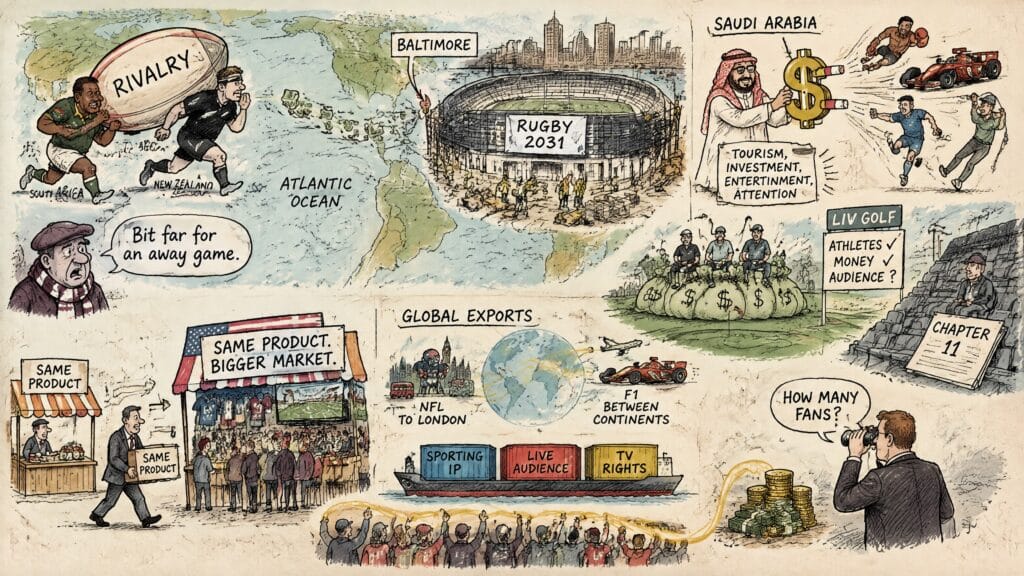
Tomorrow, South Africa and New Zealand play the fourth and final Test of their extraordinary series at M&T Bank Stadium in Baltimore. The Springboks lead 2–1 after three Tests in South Africa, and organisers are expecting something approaching 71,000 people for the first Springboks-All Blacks Test ever played in the United States.
Rugby's Greatest Rivalry heads to Baltimore — SA Rugby
There is something slightly odd about that on first inspection. South Africa against New Zealand is arguably the greatest rivalry in international rugby. For more than a century its geography has been fairly obvious: you play in South Africa or you play in New Zealand. Yet the culmination of the first full All Blacks tour of South Africa in 30 years isn't at Ellis Park, Cape Town or Eden Park. It's in Maryland.
The official explanation is entirely reasonable. America hosts the Rugby World Cup in 2031, World Rugby wants to develop the US market and Baltimore gives the sport exposure to an enormous potential audience. World Rugby chief executive Alan Gilpin has described the match as an important test ahead of 2031, and there has already been discussion about taking more major international rugby to America.
But let's not pretend nobody in the finance department has noticed.
A home Test has a natural ceiling. There are only so many seats in the stadium, only so much local supporters will pay and only so many domestic sponsors competing for access to them. Take exactly the same sporting product — same Springboks, same All Blacks, same oval ball, same Haka, same Siya Kolisi — and move it into a large, wealthy, relatively underdeveloped market and suddenly the economics change.
You haven't changed the product. You've changed the market in which you're selling it. And anyone involved in business or investing should immediately recognise that idea.
Rugby is hardly alone. Football worked this out years ago. European clubs now spend pre-seasons touring America, Asia and the Middle East because Manchester United playing Liverpool isn't merely an English sporting event anymore. It is exportable intellectual property. The NFL went in the opposite direction and began exporting American football, with London initially receiving the occasional novelty game before the international programme expanded into multiple countries. Formula One has relentlessly moved into new markets. The NBA plays overseas. Cricket has built enormously valuable competitions around the combination of broadcasters, sponsors, owners and audiences who may live thousands of miles from the game's traditional centres.
Even rugby is now looking at taking Six Nations matches to the United States, with World Rugby prepared to provide financial incentives to unions willing to move fixtures. England, rather revealingly, isn't particularly keen. A major international at Twickenham can generate around £10 million, so the RFU understandably doesn't fancy exporting something it already sells extremely profitably at home.
That tells you almost everything you need to know about the economics. The rhetoric is global development; the spreadsheet is revenue per fixture. And there is nothing inherently dishonest about that, because both can be true. Taking rugby to America can genuinely grow rugby in America while simultaneously making everyone involved more money.
Nowhere has grasped the value of sport as an economic and geopolitical asset more aggressively than Saudi Arabia. Over the past decade the kingdom has spent extraordinary sums bringing boxing, Formula One, football, tennis, golf and other major events into the country, while it will host the men's football World Cup in 2034.
Boxing is perhaps the cleanest example. Fights that traditionally belonged in Las Vegas, New York or London increasingly appear in Riyadh because Saudi organisers have been prepared to provide purses and guarantees traditional promoters struggle to match. Fighters understandably notice this. If somebody offers you several multiples of your normal earnings to punch exactly the same person in a different postcode, the philosophical debate about where the fight “belongs” can become remarkably short.
And I struggle to condemn the athlete for that. Elite sporting careers are brutally short. Rugby players get injured. Boxers accumulate damage that follows them for the rest of their lives. Cricketers spend months away from their families. If another market values their product more highly, why shouldn't they sell it there?
There is, of course, another side to the Saudi sporting story. Critics describe much of this investment as sportswashing: using the emotional power and international reach of sport to improve the reputation of a state whose human-rights record attracts considerable criticism. That argument deserves to be taken seriously, but reducing the entire strategy to sportswashing also misses something economically important. Saudi Arabia wants tourism, international investment, global relevance, entertainment industries and an economy less dependent on oil. Sport can serve all of those objectives simultaneously.
The investment isn't simply buying golfers, footballers and boxers. It is buying attention.
And attention may be one of the most valuable commodities in the modern economy.
Which brings us to LIV Golf, because if Baltimore represents one side of the globalisation of sport, LIV may be the cautionary tale sitting at the other end.
Saudi Arabia's Public Investment Fund spent billions backing LIV and using enormous signing guarantees and prize funds to persuade some of the world's best golfers to leave the established tours. Phil Mickelson was reportedly offered around $200 million, Cameron Smith around $140 million and Jon Rahm around $300 million. For a professional golfer being asked to continue playing professional golf, merely in different trousers and occasionally a different country, the economics were understandably persuasive.
But this week LIV Golf filed for Chapter 11 bankruptcy protection in the United States after its principal Saudi funding was withdrawn. This isn't necessarily liquidation — Chapter 11 gives the organisation an opportunity to restructure — but the bankruptcy documents make fairly extraordinary reading. LIV listed estimated liabilities of $500 million to $1 billion, against estimated assets of $100 million to $500 million, while some of the golfers it paid enormous sums to recruit are themselves now creditors. Jon Rahm is reportedly owed about $7.47 million, Bryson DeChambeau around $5.77 million, with Dustin Johnson, Cameron Smith and others also owed money.
The league has since received interim court approval to access $14 million in bankruptcy financing, part of a proposed $49.6 million package intended to keep it operating while it attempts to restructure.
And then you get into the wonderful details that bankruptcy proceedings have a habit of exposing. The player agreements reportedly included highly individual arrangements involving equity, legal indemnities and insurance benefits, with one agreement even providing for LIV to cover a player's Cigna health-insurance plan. After billions spent on signing bonuses, private jets, enormous prize funds and an attempt to overthrow the established structure of professional golf, somebody still remembered to get the medical insurance thrown in.
Frankly, good for him.
But beneath the comedy is a very important commercial lesson. LIV proved beyond reasonable doubt that money can buy athletes. What it cannot necessarily buy is an audience. Offer elite sportspeople substantially more money and many of them will move; I don't particularly blame them. Their careers are finite and their earning window is short. What billions of dollars couldn't automatically manufacture was the history, emotional attachment and audience habits surrounding the Masters, the Open, the Ryder Cup and the established professional tours.
Sport is commercially valuable because it contains something most businesses would kill for: inherited customer loyalty. People don't normally inherit their preferred supermarket from their grandfather. Nobody takes their eight-year-old child aside and solemnly explains that the family has banked with HSBC for four generations and, whatever happens, they must never open an account with Barclays.
Sport does that.
And that makes sporting audiences extraordinarily valuable and extraordinarily difficult to manufacture from scratch.
That emotional attachment also explains why companies pour staggering amounts into sports sponsorship. A business paying to put its logo on Manchester United's shirt, an F1 car or beside a cricket boundary isn't really buying fabric, paint or television pixels. It is purchasing temporary access to somebody else's emotional relationship.
The same applies increasingly to the athletes themselves. Social media has removed much of the intermediary between sportspeople and their audiences. A footballer with 50 million followers isn't simply an employee of a football club anymore. He owns a distribution network. Two players of broadly similar ability can therefore have dramatically different commercial values because one possesses an enormous international audience. A club signing that player may acquire sporting performance, shirt sales, social-media engagement, sponsorship leverage and access to an entirely new geographical market in one transaction.
In financial language, the athlete has multiple revenue streams. In football language, he's good on Instagram.
And the relationship runs both ways. Sponsors want athletes because athletes possess audiences, athletes want global exposure because global exposure increases their commercial value, and sporting organisations want new countries because new countries create new audiences. The entire system is essentially a competition to find somewhere else to sell the same attention.
This is where tomorrow's match in Baltimore becomes interesting beyond rugby. South Africa and New Zealand haven't invented a new game for America. They haven't made the pitch circular, added another ball or asked Rassie Erasmus to introduce a three-point conversion sponsored by Coca-Cola. They're selling precisely the same product somewhere that may value it differently.
That principle appears everywhere in markets. A product can be mature in one geography and explosive in another. A company can struggle to grow domestically yet transform its economics by entering a market where customers have greater purchasing power, competition is weaker or demand is only beginning to develop. Investors sometimes become obsessed with improving the product when the more important question is whether the product is being sold in the right place.
The Springboks and All Blacks can sell out stadiums in South Africa. That's wonderful, but South African rugby supporters already know who they are. The marginal commercial value of introducing another South African to Siya Kolisi is fairly limited. Put him in front of tens of thousands of people in Baltimore, broadcast the game across America five years before a US Rugby World Cup and suddenly the same eighty minutes have a completely different strategic purpose.
It isn't abandoning tradition. It is exporting it.
And that is the crucial distinction between something like tomorrow's Test and the lesson emerging from LIV Golf. Moving an established sporting product into a more valuable market can work brilliantly because you're taking the emotional attachment with you. Creating an entirely new product and trying to purchase that emotional attachment from scratch is much harder. Capital can amplify demand; it is considerably less reliable at manufacturing it.
There will always be people who dislike all of this. They want Test rugby played at traditional grounds, heavyweight fights in Madison Square Garden and football clubs playing at three o'clock on Saturday rather than at whichever time best accommodates a television audience somewhere else in the world. I sympathise with quite a lot of that. Sport loses something if every decision becomes a revenue-optimisation exercise. Rivalries matter because of history, geography and supporters. Move everything around often enough and eventually you risk damaging precisely the emotional attachment you're trying to monetise.
LIV Golf should probably be pinned to the wall of every sports executive's office as a reminder of that. Capital can accelerate something people want. It cannot indefinitely force them to want something they don't.
But there is another danger in romanticising the old model. Professional sport costs enormous amounts of money. Players need paying, academies need funding, stadiums need maintaining and broadcasters and sponsors increasingly operate globally. If playing one match in America materially improves the economics of a rugby series, grows the sport ahead of 2031 and ultimately puts more money into the unions and the players actually providing the entertainment, I find it difficult to get terribly upset about the flight.
Especially in rugby, where the people putting their bodies through something resembling a minor motorway accident every Saturday have spent rather too much of the professional era receiving a disproportionately small share of the value they create.
So tomorrow I'll watch the Springboks and All Blacks playing one of rugby's oldest rivalries in a city approximately 12,000 kilometres from Johannesburg. Part of me will think it looks slightly peculiar. The capitalist in me will think it makes perfect sense.
Because one of the oldest lessons in markets is also becoming one of the most important lessons in sport: sometimes you don't need a better product. You just need to find a bigger market for the one you already have.
But LIV has added an equally important footnote.
Make sure the market actually wants it.
Keep your Axe sharp.
Max
Join the FX Axe newsletter and stay one chop ahead.

