

There was a rather good headline in The Times on Tuesday, courtesy of Ben Wilkinson, suggesting that investors ought to pull themselves together because stock markets are supposed to crash. It's a sentiment with which I have considerable sympathy, particularly given the extraordinary levels of hysteria that accompany a relatively substantial fall in the financial markets these days.
Whenever the stock market suffers a particularly unpleasant morning, financial television suddenly adopts the tone of a broadcaster announcing the outbreak of a world war. Red graphics appear everywhere, presenters start speaking in unusually sombre voices, and somebody inevitably wheels out an economist to explain why the events of the previous twenty-four hours were entirely predictable, despite apparently neglecting to mention them twenty-five hours earlier.
What I find particularly amusing is that people who have spent years telling me they are long-term investors suddenly become exceptionally short-term investors when something goes wrong. A man with a thirty-year investment horizon finds himself checking the performance of his pension every seventeen minutes, before announcing to his wife that they may have to reconsider their proposed holiday to Portugal in 2043.
Markets go up. Markets go down. They occasionally go down rather spectacularly. This is not a manufacturing defect in the financial system; it is an inherent feature of it. And, depending on how you approach financial markets, a crash can present some rather interesting opportunities.
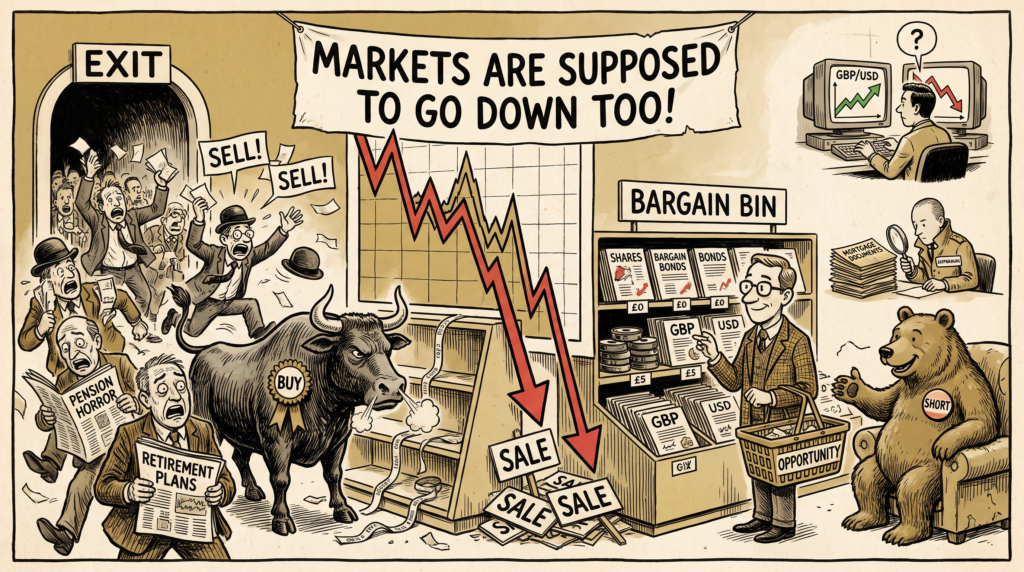
Imagine walking into a shop and discovering that the television you've been considering buying for the past six months has suddenly been reduced from £1,000 to £700. Most people would be absolutely delighted. You might purchase it immediately, congratulate yourself on your extraordinary financial acumen and spend the remaining £300 on something else you don't need.
Yet when something similar happens in the stock market, human beings frequently display the precise opposite behaviour. They enthusiastically purchase shares when prices are at record highs, only to become considerably less enthusiastic when those same shares become available at a substantial discount.
Obviously, the comparison isn't entirely perfect. A television reduced in price remains broadly the same television, whereas a company's share price may have fallen because something has fundamentally deteriorated within the business. If you've discovered that your television manufacturer has inadvertently produced several million televisions that burst into flames during Gardeners' World, the discount is perhaps less attractive.
Nevertheless, the broader principle remains interesting. If you believed a business represented an attractive long-term investment at £100 per share, and its fundamental prospects haven't materially changed, why would you automatically consider it a less attractive investment at £70?
Much of the answer lies in human psychology. When prices are rising, we feel reassured by the fact that everybody else appears to agree with us. When prices are falling, we begin to question our judgement because everybody else appears to be heading for the exit.
It's a peculiar arrangement in which the average investor is often most comfortable purchasing something when it is most expensive and most uncomfortable purchasing it when it is considerably cheaper.
Throughout the history of financial markets, there have been numerous occasions on which people have convincingly argued that the entire system was about to collapse. And, admittedly, on several occasions they had a reasonably persuasive argument.
The Wall Street Crash of 1929 was followed by the Great Depression. Black Monday in October 1987 saw the Dow Jones Industrial Average fall by approximately 22.6% in a single trading session. The collapse of the dot-com bubble wiped out enormous amounts of wealth at the beginning of this century, and the global financial crisis of 2008 threatened the stability of some of the world's most important financial institutions.
Then came Covid. Between February and March 2020, the S&P 500 fell by approximately 34% before recovering its previous high by August of the same year. Investors had gone from discussing the possible collapse of the global economy to celebrating record American stock market valuations in approximately six months, much of which they spent sitting at home in their pyjamas attempting to establish how Zoom worked.
None of this is to suggest that markets always recover quickly. Following the 1929 crash, the Dow Jones took until 1954 to regain its previous nominal price high. Individual companies can disappear entirely, and certain national stock markets have endured remarkably long periods of stagnation.
But the history of diversified equity markets is also a history of businesses adapting, economies developing, innovation creating new industries and capital gradually finding its way towards productive opportunities. The world has an extraordinary capacity to continue doing business despite the seemingly endless efforts of politicians, bankers and occasionally the bankers' own accountants to make that as difficult as possible.
One of the most important distinctions in all of this, particularly for those of us involved in the trading world, is that investing and trading are fundamentally different activities.
A conventional long-term equity investor is generally looking to participate in the growth of businesses over time. They purchase shares, potentially receive dividends and hope that the companies in which they have invested become increasingly valuable.
A trader, however, is not necessarily interested in whether an asset becomes more valuable over the next twenty years. A trader may simply be interested in whether it becomes more or less valuable over the next twenty minutes.
And crucially, traders can potentially make money in either direction.
If you believe an asset is going to rise, you can take a long position. If you believe it is going to fall, you can take a short position. Your financial success is not necessarily dependent upon the economy enjoying a particularly pleasant afternoon.
This is one of the more fascinating aspects of financial markets. Two traders can look at precisely the same asset, arrive at entirely different conclusions and both make money, provided they are operating over different timeframes.
One might believe that gold is going to fall during the next hour, whilst the other believes it will appreciate considerably over the next six months. Both could be entirely correct. There is no inherent contradiction, although put the two of them in the same room and they'll probably spend the afternoon calling one another idiots.
Financial markets have developed a rather entertaining collection of animal terminology over the centuries. Bulls are associated with rising markets, supposedly because a bull attacks by thrusting its horns upwards. Bears are associated with falling markets, traditionally explained by the downward motion of a bear's swipe, although the precise historical origins of these expressions are debated.
There is also an old Wall Street expression suggesting that bulls make money, bears make money, but pigs get slaughtered. It's a rather brutal little observation about the dangers of greed, although one imagines the agricultural community would argue that the pig has been rather unfairly represented.
What matters is that neither a bullish nor a bearish position is inherently superior. Both represent a view about the future direction of an asset. A trader who correctly anticipates a substantial decline can potentially make just as much money as somebody who correctly anticipates a substantial rise, depending on their position size, instrument and associated costs.
For example, imagine a company's shares are trading at £100. A trader anticipating a decline borrows ten shares and sells them for £1,000. If the price subsequently falls to £70, the trader can repurchase those ten shares for £700, return them to the lender and retain the £300 difference, before borrowing costs and other expenses.
The company has lost market value. Its shareholders have suffered a disappointing afternoon. Somebody else has made £300.
Of course, if the shares instead rise to £150, buying them back costs £1,500, leaving the short seller with a £500 loss. Conventional short selling carries the particularly unpleasant characteristic that the potential loss is theoretically unlimited, because there is no theoretical ceiling on how high a share price can rise.
There is a substantial difference between identifying that something is overpriced and identifying when everybody else is going to realise it. Financial markets have an extraordinary capacity to make intelligent people look thoroughly ridiculous whilst waiting for their predictions to come true.
Perhaps the most famous modern example of profiting from a market collapse is Michael Burry, whose experiences were subsequently immortalised in The Big Short.
Burry examined the American housing market in the years preceding the global financial crisis and identified serious weaknesses in mortgage lending and the financial instruments built around those mortgages. He concluded that the market was considerably more vulnerable than prevailing opinion suggested and used credit default swaps to position himself against it.
What makes his story particularly fascinating is that being correct was initially an extraordinarily expensive experience. His fund incurred ongoing costs, investors became increasingly frustrated, and the financial institutions on the other side of his positions continued to behave as though everything was perfectly satisfactory.
Eventually, the housing market collapsed, and Burry's positions generated enormous profits.
The important lesson here is not simply that he made money during a crash. It's that he had identified a specific structural weakness, conducted extensive research, selected an appropriate instrument and maintained his position through a prolonged period in which the market appeared to disagree with him.
Watching The Big Short on a Sunday evening and deciding to short the Nasdaq on Monday morning is not quite the same thing, although I suspect it has happened on more than one occasion.
The foreign exchange market offers perhaps the clearest illustration of why falling prices needn't automatically be considered bad news for traders.
Unlike a conventional share investment, a currency trade is inherently a comparison between two assets. When you trade GBP/USD, for example, you're expressing a view about the relative value of the British pound against the American dollar.
If you go long GBP/USD, you're buying pounds and selling dollars. If you go short GBP/USD, you're effectively selling pounds and buying dollars. One currency's relative weakness is the other's relative strength, which makes the concept of a universally falling currency market rather peculiar.
Imagine GBP/USD falls from 1.35 to 1.25. A British tourist planning a particularly extravagant holiday to Florida might regard this as deeply disappointing. An American tourist visiting London might be absolutely delighted. A forex trader who had correctly anticipated the decline could potentially have made a substantial profit.
The same economic development has produced three entirely different experiences.
This becomes particularly interesting during periods of geopolitical uncertainty or financial instability. Investors may move capital away from currencies perceived to be more vulnerable and towards currencies traditionally considered safer, such as the Swiss franc or, in many circumstances, the American dollar.
Meanwhile, commodity-exporting currencies can respond to movements in oil, metals and other raw materials. Interest rate expectations can alter the relative attractiveness of holding different currencies, and political developments can cause significant movements in exchange rates.
The world does not need to be experiencing widespread economic prosperity for a forex trader to identify an opportunity. In fact, a perfectly uneventful world in which interest rates never changed, politicians behaved sensibly and currencies barely moved would probably be extraordinarily tedious for currency traders.
Although the rest of humanity might consider it quite a welcome development.
Traders frequently talk about volatility as though it were an inherently desirable characteristic, and there is some logic to that. If the price of an asset never moves, there is very little opportunity to profit from changes in its price.
However, there is an important distinction between volatility and predictability. A market moving dramatically does not necessarily mean that you have any greater ability to anticipate which direction it will move next.
Market crashes can produce violent reversals. An index can fall substantially in the morning, recover much of its losses in the afternoon and then proceed to do something entirely different the following day. Liquidity can deteriorate, spreads can widen and stop-loss orders can be executed at considerably less favourable prices than traders anticipated.
Add leverage into the equation and things become particularly entertaining, provided you're watching somebody else's trading account.
Imagine having £1,000 in your account and using leverage to control a £20,000 position. A favourable 5% movement in the underlying asset could generate a profit equivalent to your entire original capital, before costs. An unfavourable movement of the same magnitude could theoretically wipe it out, although margin requirements might close your position considerably earlier.
The volatility itself isn't the opportunity. The opportunity lies in your ability to identify a trade with a favourable relationship between its potential return and its potential risk.
There is little point correctly predicting that the market will eventually fall by 20% if you've structured your position in such a way that a temporary 3% rise bankrupts you before it happens.
I also think it's worth emphasising that there is absolutely nothing contradictory about being a long-term investor who believes in the growth of financial markets whilst simultaneously being a trader who occasionally profits from their decline.
You might hold investments in a diversified pension portfolio because you believe the global economy will continue developing over the next thirty years, whilst also taking a short-term bearish position on a particular index because you believe its immediate valuation is excessive.
These are separate decisions with separate objectives, timeframes and risk considerations.
The problems tend to arise when people begin confusing the two. A trader enters a position intending to hold it for twenty minutes, discovers that it has fallen substantially and suddenly announces that they are now a long-term investor.
This is not an investment strategy. It is the financial equivalent of missing your motorway exit and deciding that you had always intended to visit Birmingham.
Equally, a long-term investor who sells their entire portfolio during a particularly unpleasant trading session may be abandoning a carefully considered financial plan in response to events that have little bearing on their original investment horizon.
Understanding why you own something, how long you intend to own it and what circumstances would cause you to change your mind is considerably more important than whether the market happens to be red or green on any particular afternoon.
One of the expressions I particularly dislike in financial reporting is that everybody is selling. Whilst it conveys the general sentiment of a falling market, it rather neglects an important feature of how transactions work.
For every completed sale, there is a buyer.
Prices fall because sellers are increasingly willing to accept lower prices and buyers are unwilling to consistently pay the previous ones. The market is attempting to establish a price at which those competing interests can transact.
The person selling a share at £70 might believe it is heading towards £40. The person buying it might believe it will eventually return to £100. Both are acting on their own interpretation of the available information, and both believe the transaction represents a sensible financial decision.
Without these differences of opinion, there would be remarkably little reason for financial markets to exist.
Which is why I find the idea that everybody should be cheering for permanently rising markets rather odd. Falling markets can expose weaknesses in poorly managed companies, challenge unsustainable valuations and create opportunities for capital to be deployed more efficiently. They can also present opportunities for traders who have positioned themselves appropriately.
Crashes can, of course, have devastating consequences for ordinary people, businesses and employment. There is nothing particularly desirable about a financial crisis causing families to lose their homes or livelihoods. Understanding how to navigate falling markets is not the same thing as celebrating the economic suffering that can accompany them.
But neither should we view every decline in financial asset prices as an inherently undesirable event.
I think the fundamental problem is that we have become rather accustomed to measuring financial success by whether a number on a screen is green. Rising prices are celebrated, falling prices are mourned, and an extraordinary amount of financial commentary is devoted to explaining the apparent emotional wellbeing of an index that is entirely incapable of experiencing emotions.
For long-term investors, a market decline may present an opportunity to purchase quality assets at more attractive valuations. For traders, it may present an opportunity to profit from falling prices, subsequent recoveries or movements between different assets and currencies.
Neither opportunity comes with a guarantee, and both require rather more consideration than simply purchasing something because it has become cheaper or shorting it because it has started falling.
Perhaps the most valuable skill in financial markets is learning to become considerably less emotionally attached to the direction in which they are travelling.
The market doesn't know that you've bought something. It doesn't care that you've sold something. It has absolutely no interest in your plans to retire at fifty-five, your impending kitchen renovation or the fact that you've promised your wife a rather expensive holiday to Portugal.
It is simply a mechanism through which millions of participants continuously reassess the value of things.
Sometimes those things become more expensive. Sometimes they become cheaper. Sometimes everybody gets terribly excited about something, values it at several trillion dollars and then spends the following week reconsidering their collective enthusiasm.
That's what markets do. Rather than becoming increasingly irritated with them for behaving precisely as they are supposed to, perhaps we should spend a little more time understanding how to operate in both directions.
Keep that Axe sharp. Whether you're dealing with bulls or bears, try not to be the pig.

Sources & Further Reading
Join the FX Axe newsletter and stay one chop ahead.

