

The U.S. dollar regained momentum on Thursday after the Federal Reserve kept interest rates unchanged, with investors closely watching the central bank’s next steps. While the Fed’s decision was largely expected, uncertainty around future policy direction created fresh volatility across currency markets.
The question many forex traders are asking is: why the Dollar recovered after the Fed’s decision despite the initial weakness following the announcement?
The answer comes down to a combination of Fed uncertainty, rising Treasury yields, geopolitical risks, and changing expectations about future interest rate policy.
The Federal Reserve decided to keep its policy rate unchanged in a 9–3 vote. However, the focus quickly shifted away from the decision itself and toward comments from Fed Chair Kevin Warsh.
Three policymakers pushed for a rate increase, highlighting a divide within the central bank over whether inflation risks remain high enough to justify tighter policy.
Warsh did not provide a clear signal on whether further tightening could happen soon, leaving investors uncertain about how the disagreement among policymakers would develop.
This uncertainty explains part of why the Dollar recovered after the Fed’s decision, as traders reassessed whether U.S. interest rates could remain higher for longer.
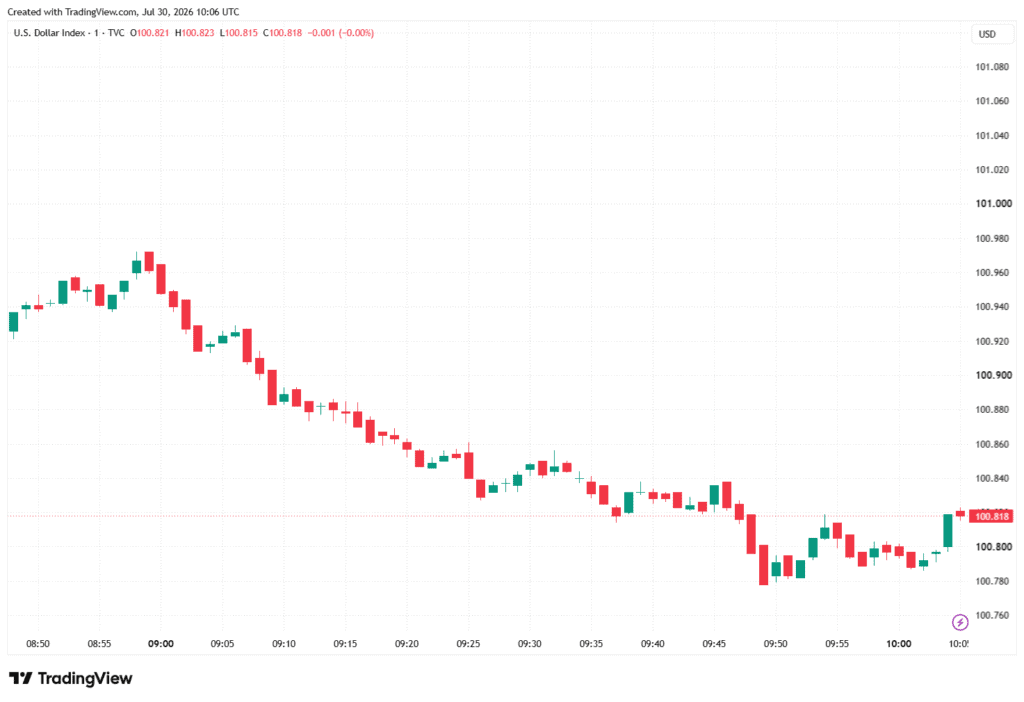
The U.S. Dollar Index (DXY), which measures the greenback against six major currencies, edged higher by around 0.1% to 100.93 during Asian trading.
The dollar had initially weakened after the Fed announcement but later found support as investors turned toward safer assets.
Renewed geopolitical tensions also played a role. Reports of U.S. air strikes in Iran increased demand for traditional safe-haven currencies, helping the dollar recover some of its earlier losses.
This was another factor behind why the Dollar recovered after the Fed’s decision, as markets balanced monetary policy uncertainty with global risk concerns.
Another major driver behind the dollar’s rebound was movement in the U.S. bond market.
Treasury yields moved sharply higher after the Fed meeting, with the 30-year yield reaching its highest level in almost two decades.
Higher yields can support the U.S. dollar because they may attract investors looking for stronger returns from U.S. assets.
However, the bond market reaction also showed that investors remain concerned about inflation expectations and whether the Fed is doing enough to keep price pressures under control.
This explains why the Dollar recovered after the Fed’s decision, as traders focused not only on the Fed’s current decision but also on the broader outlook for interest rates.
Following the meeting, traders continued adjusting their expectations for future Fed policy.
Fed funds futures showed that markets increased the probability that the central bank could keep rates unchanged at its next meeting, compared with expectations before the latest decision.
Some analysts believe the dollar’s recent weakness could be temporary.
HSBC analysts noted that expectations for future Fed tightening and continued U.S. economic strength could provide support for the greenback.
Meanwhile, Standard Chartered’s global head of G10 FX research, Steve Englander, highlighted concerns that unclear communication from the Fed could create challenges if markets believe policymakers are delaying necessary action.
These conflicting views explain why the Dollar recovered after the Fed’s decision, as investors weighed both potential rate risks and economic resilience.
The dollar recovery affected major currency pairs.
EUR/USD slipped toward 1.1453 as the greenback regained strength.
GBP/USD weakened ahead of the Bank of England’s interest rate decision, with traders waiting for fresh guidance on future monetary policy.
USD/JPY remained elevated near 163.46 as higher U.S. yields continued supporting the pair, while traders stayed alert for possible intervention concerns from Japanese officials.
The next major driver for the dollar will be how markets interpret upcoming economic data and whether Fed officials provide clearer guidance on future policy.
Traders will continue monitoring inflation figures, employment data, and comments from central bank officials.
Understanding why the Dollar recovered after the Fed’s decision is important because currency markets often react more to expectations than the actual policy decision itself.
The Fed may have kept rates unchanged, but the debate over inflation, interest rates, and future tightening remains far from over.
The dollar’s recovery after the Federal Reserve meeting was not driven by a single factor. Instead, it came from a combination of higher Treasury yields, safe-haven demand, and uncertainty surrounding the Fed’s future direction.
For traders asking why the Dollar recovered after the Fed’s decision, the key takeaway is that markets are always looking ahead. The Fed’s decision matters, but the expectations surrounding future policy often create the biggest moves.
As volatility continues, keeping up with central bank decisions and understanding market reactions can help traders better navigate major forex events.
Stay updated with forex news, broker reviews, and trading education through FX Axe.
Follow us for more market breakdowns and forex education at FX Axe YouTube Channel.
Watch out for our upcoming video on How Federal Reserve and Central Banks Move the Forex Market.

