

There was a time when finding out where to invest your money required a newspaper, a stockbroker, several annual reports and, depending on your level of wealth, a man called Nigel in a pinstriped suit who charged you 1.5% a year to explain that equities tend to outperform cash over the long term.
Things have moved on rather quickly. According to new research highlighted by the Financial Conduct Authority, four out of five young investors now use artificial intelligence to help them make investment decisions, and more than half say they trust it. AI is already more trusted by these investors than television, radio and, rather encouragingly, social-media influencers.
Hardly surprising, really. If my choice is between asking an AI system capable of searching, comparing and explaining enormous quantities of financial information, or taking investment advice from somebody filming themselves beside a rented Lamborghini in Dubai while pointing at the words FINANCIAL FREEDOM floating above their head, I know where I’m starting. I stress starting, because our new benevolent robot overlords have some fairly substantial shortcomings of their own.
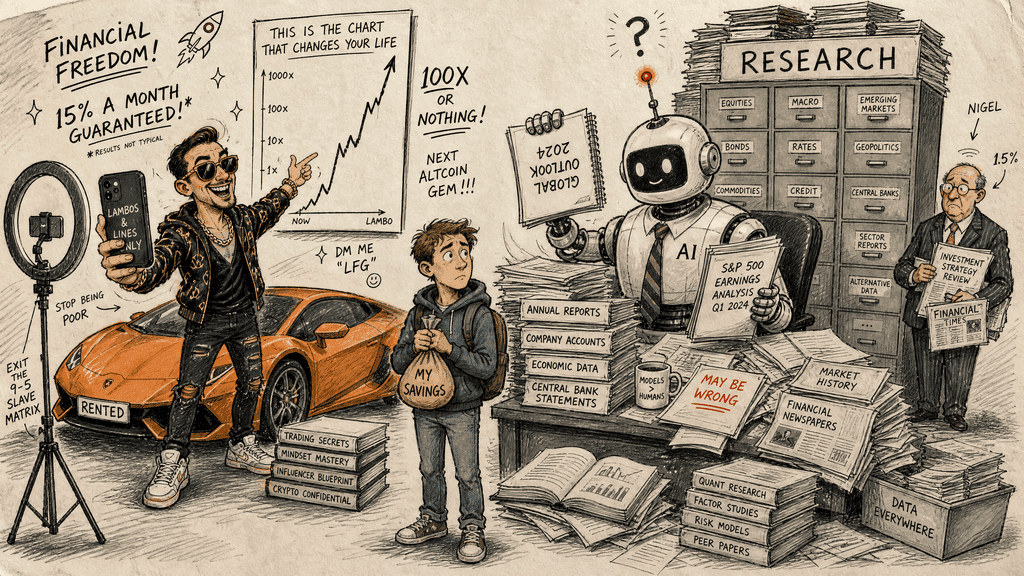
The FCA research questioned 666 people aged between 18 and 40, which is an almost unnecessarily good sample size for a study about humans beginning to entrust their financial futures to artificial intelligence.
I’m assuming it was accidental. Nevertheless, somewhere on social media somebody is presumably already connecting this to the Illuminati, central-bank digital currencies and a photograph of Beyoncé making a triangle with her hands.
The actual findings are much more interesting. Four in five respondents used AI for investment assistance and more than half trusted what it told them. Fewer than one in three trusted social-media influencers, while just under half trusted television and radio. Separate research suggests this is not some tiny technological niche either: almost eight in ten Gen Z investors have used AI to learn about investing, alongside three-quarters of Millennials, 47% of Gen X and even 17% of Baby Boomers.
So this isn’t really a story about whether AI will enter investing. It already has, and the more interesting question is what we do with it now that it’s here.
Think about how extraordinary the change in access to financial information has been. Not very long ago, a private investor trying to understand an unfamiliar market might begin with the Financial Times, company accounts, analyst research, books, a broker or a professional adviser. If you wanted sophisticated institutional research, somebody generally had to pay quite a lot of money for it.
The internet democratised much of that information, and social media subsequently democratised the people commenting on it. That second development has had rather more mixed results. There are excellent financial commentators online, including professional traders and economists who explain complicated subjects beautifully and give away material that would once have been extremely difficult for ordinary investors to access. These blogs and videos to use a very good example. There are also people whose principal qualification appears to be owning a ring light.
The FCA says 62% of 18-to-29-year-olds follow social-media influencers, with 74% of those followers saying they trust their advice and nine out of ten saying influencers have encouraged them to change their financial behaviour. That matters when the subject changes from moisturiser to leveraged CFDs.
The regulator has consequently been rather busy. An international crackdown led by the FCA this year involved 17 regulators, while in Britain alone the authorities secured a guilty plea relating to illegal social-media promotions, issued warnings and requested the removal of 1,267 illegal financial adverts that had reached at least 2.3 million UK accounts. Turns out “not financial advice, babes x” isn’t quite the regulatory force field some people hoped it was.
Which brings us inevitably to Kim Kardashian.
I should say before proceeding that Kardashian has built an astonishingly successful business empire. Whatever you think of the route by which she first became famous, converting celebrity into businesses worth billions is an achievement that rather conclusively demonstrates she isn’t stupid. Her original media breakthrough was, shall we say, a fairly passive performance in a bedroom, and if we’re allocating the entertainment royalties purely according to workload, Ray J may have grounds to request a recount.
But none of this means I want Kim Kardashian choosing my crypto portfolio.
In 2021, Kardashian promoted EthereumMax’s EMAX token to her enormous Instagram following. The US Securities and Exchange Commission subsequently found that she had been paid $250,000 for the promotion without properly disclosing the payment. She settled the charges without admitting or denying the SEC’s findings and agreed to pay $1.26 million in penalties, disgorgement and interest.
She wasn’t alone. Regulators have pursued crypto-touting cases involving a wonderfully eclectic collection of celebrities, including Lindsay Lohan, Jake Paul, Lil Yachty, Ne-Yo, Akon, Soulja Boy and NBA Hall of Famer Paul Pierce. There is nothing inherently wrong with celebrities having opinions about investments; the problem is confusing audience with expertise. Being very good at reality television doesn’t make you an investment analyst any more than being very good at trading EUR/USD qualifies you to perform an appendectomy. I have some thoughts on surgery, for example. You should absolutely not use them.
This is where I think the migration from influencers towards AI is potentially very positive, because an influencer essentially gives you their answer, whereas AI allows you to interrogate an answer.
You can ask why. You can ask what assumptions underpin it, what the strongest counterargument is, what happened historically under similar conditions and what would invalidate the thesis. You can ask it to compare two assets, explain a balance sheet, pull apart an economic argument or translate the latest central-bank statement from the peculiar dialect of English in which central bankers have collectively agreed to communicate.
And then, crucially, you can ask for the sources and go and check them yourself.
That isn’t the same thing as outsourcing your investment decisions to a machine. Used properly, it is almost the opposite: it gives an ordinary investor a research assistant that can help them ask more questions and challenge the answers they already think they know. That sort of capability would have been prohibitively expensive for most private investors not very long ago. Today you can do it while waiting for a coffee.
Unfortunately, there is one fairly important complication: AI can also talk absolute bollocks.
It can misunderstand context, rely on outdated information, confuse similarly named companies, invent supporting details or present something uncertain with the serene confidence of a hedge-fund manager who has just discovered a television camera. Young investors seem reasonably aware of this — nearly three-quarters in the FCA survey recognised that AI could provide inaccurate information — but there are some worrying gaps. Some 44% wrongly believed AI-generated financial advice was regulated, while 32% thought they could receive compensation if AI advice caused them to lose money.
Generally speaking, they can’t. A general-purpose chatbot isn’t your regulated financial adviser. There isn’t necessarily a professional who knows your circumstances, has assessed whether something is suitable and can ultimately be held accountable for the recommendation.
That is the difference between using AI as a tool and treating AI as an oracle, and it’s a fairly important distinction. One is potentially transformative; the other is just replacing the bloke on TikTok with a considerably more articulate bloke who happens to live in a server, and can be programmed to encourage you in your wildest thoughts.
This is probably the most important point for traders. If your entire investment process is typing What stock will go up tomorrow? into ChatGPT and transferring your pension accordingly, we haven’t actually advanced very far. We’ve simply automated the tipster.
The real advantage is using AI to attack your own thinking. Suppose you believe sterling is going higher. Rather than asking a machine to produce fifteen reasons why you are clearly a financial genius, ask it to build the strongest possible case that you’re wrong. Ask which economic releases would damage the thesis, what the options market is signalling, how similar interest-rate environments have historically affected sterling and what evidence should make you abandon the trade.
The same principle applies elsewhere. If you’re considering a broker, ask where it’s regulated, what client protections exist, what the spreads are, whether there have been enforcement actions and how its execution model works. If somebody offers you an investment promising 15% a month, ask AI to calculate what £10,000 compounded at 15% monthly becomes after five years.
It’s about £44 million.
At that point, perhaps ask yourself why the gentleman offering you this extraordinary opportunity still needs your £10,000.
AI’s great investing advantage isn’t that it knows the future, because it doesn’t. It’s that it dramatically reduces the cost and effort required to ask better questions.
Perhaps the most interesting part of this shift is that it isn’t going to remain a Gen Z phenomenon. Government research published this summer found that 59% of UK adults had used generative AI during the previous three months. Usage was above 75% among everyone under 45, but even 18% of 75-to-84-year-olds had already used it, with easier access to information and advice among the most commonly identified benefits.
The same pattern is appearing in finance. One 2026 study found 55% of UK adults already use AI platforms for financial guidance at least sometimes, while HSBC found that 73% of affluent investors globally were using AI in finance and investment. Interestingly, only 12% of the latter group said AI was the most influential factor in their most recent investment decision; human professionals and institutions remained the leading source of ideas.
That sounds about right to me. AI isn’t necessarily replacing expertise. It is changing who gets access to it, how quickly they can interrogate it and how much preliminary work they can do themselves before deciding whether they actually need to pay Nigel. I know, because in previous life, I was a Nigel.
For most of financial history, information was scarce and expensive. We have now arrived at almost the opposite problem: information is effectively infinite, and judgement has become the scarce commodity.
AI can read faster than you, compare more things than you and explain an unfamiliar concept without becoming irritated when you ask the same question four different ways. It can help analyse scenarios, challenge assumptions and turn an incomprehensible central-bank statement into something resembling English, but it cannot remove uncertainty from markets. Nobody can.
The trader still has to decide what matters, what to trust, how much risk to take and, perhaps most importantly, when the evidence has changed enough to admit that the original idea was wrong.
So am I surprised that young investors increasingly trust AI? Not remotely. Given that one of the alternatives has sometimes been taking crypto tips from celebrities who were paid a quarter of a million dollars to post them, I’d call it progress.
Just remember that your benevolent robot overlord is probably best employed as your research department rather than your fund manager. Ask it questions, challenge it, make it argue against you and check the sources it gives you before putting your own money on the line.
Then make your own bloody decision.
Although if it ever suggests surveying exactly 666 people, perhaps switch it off.
Keep your Axe sharp, and your prompts sharper.
Max
Want more of The Daily Chop?
Sharp market stories, trading takes and financial madness straight to your inbox.

