EURUSD Bid: --
USDJPY Bid: --
GBPUSD Bid: --
USDCHF Bid: --
AUDUSD Bid: --
USDCAD Bid: --
NZDUSD Bid: --
EURGBP Bid: --
GBPJPY Bid: --
WTI Bid: --
BRENT Bid: --
XAUUSD Bid: --
XAGUSD Bid: --
SPX500 Bid: --
DAX40 Bid: --
US30 Bid: --
JPN225 Bid: --
NAS100 Bid: --
UK100 Bid: --
BTCUSD Bid: --
ETHUSD Bid: --
LTCUSD Bid: --
XRPUSD Bid: --
EURUSD Bid: --
USDJPY Bid: --
GBPUSD Bid: --
USDCHF Bid: --
AUDUSD Bid: --
USDCAD Bid: --
NZDUSD Bid: --
EURGBP Bid: --
GBPJPY Bid: --
WTI Bid: --
BRENT Bid: --
XAUUSD Bid: --
XAGUSD Bid: --
SPX500 Bid: --
DAX40 Bid: --
US30 Bid: --
JPN225 Bid: --
NAS100 Bid: --
UK100 Bid: --
BTCUSD Bid: --
ETHUSD Bid: --
LTCUSD Bid: --
XRPUSD Bid: --

How to Build a Trading Strategy: Step-by-Step Guide for Beginners

Posted: 30th Jun 2026

How to Build a Trading Strategy: Step-by-Step Guide for Beginners

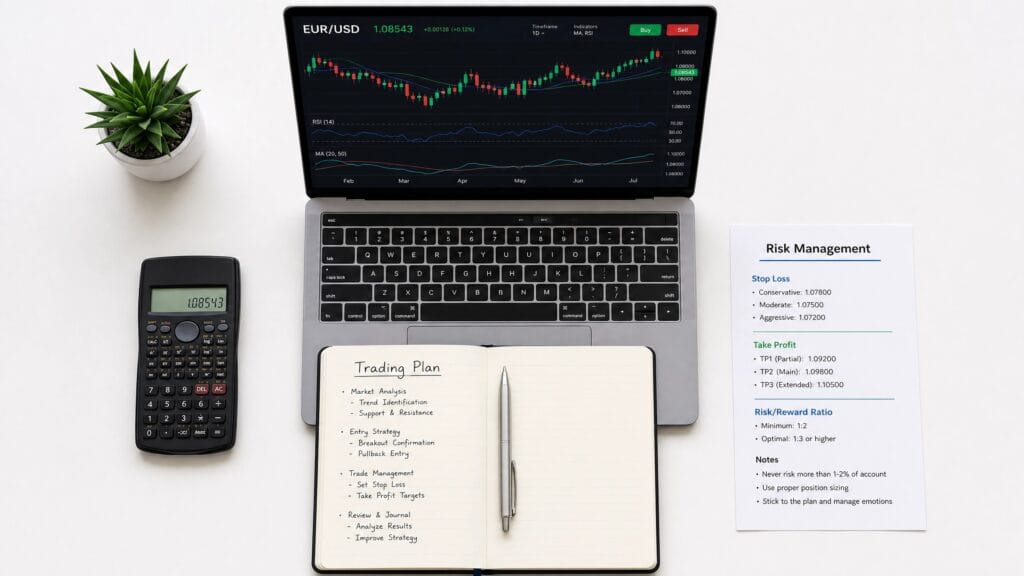
Flat lay of forex trading strategy concept: laptop with charts, notebook with trading plan, pen, calculator, and risk management notes, clean minimal workspace, professional lighting

If you want to succeed in trading, you need more than luck or random trades. You need a clear trading strategy.

A trading strategy is a simple set of rules that tells you when to enter a trade, when to exit, and how much to risk. Without it, most beginners lose money because they trade based on emotions instead of logic.

In this guide, you will learn how to build a trading strategy step by step, even if you are a complete beginner in forex trading.

If you are new to trading platforms, you can also explore our guide on MT4 vs MT5 to understand which platform suits your trading style.


What Is a Trading Strategy?

A trading strategy is a plan you follow every time you trade the market. It removes guesswork.

A basic trading strategy answers these questions:

  • When do I enter a trade?
  • When do I exit a trade?
  • Where do I place my stop-loss?
  • Where do I take profit?
  • How much do I risk per trade?

A good forex trading strategy is simple, repeatable, and easy to follow.


Why You Need a Trading Strategy

Many beginner traders fail because they trade without structure. They jump in and out of trades based on emotions or news.

A trading strategy helps you:

  • Stay consistent in the forex market
  • Avoid emotional trading decisions
  • Control risk on every trade
  • Improve discipline
  • Track your performance over time

Without a strategy, trading becomes gambling.


Step 1: Set Clear Trading Goals

Before you build any strategy, decide what you want.

Ask yourself:

  • Do I want short-term income or long-term growth?
  • How much time can I spend trading?
  • What is my risk tolerance?

Your goals will shape your trading plan and style.


Step 2: Choose Your Market

Next, choose what you will trade:

  • Forex (most popular for beginners)
  • Stocks
  • Indices
  • Commodities
  • Crypto

Most beginners start with forex trading because it is liquid and open 24 hours a day.

Need help in finding the right broker for you? Explore FX Axe's real-time and unbiased broker reviews.


Step 3: Pick a Trading Style

There are different trading styles. Choose one that fits your lifestyle.

Scalping

  • Very fast trades (minutes)
  • High pressure
  • Requires full attention

Day Trading

  • Trades opened and closed the same day
  • Medium speed

Swing Trading

  • Trades held for days or weeks
  • Best for beginners with less screen time

Position Trading

  • Long-term trades (weeks or months)

Pick one style and stick to it. Don’t switch often.


Step 4: Build a Simple Trading Setup

Your trading setup is the core of your strategy.

Keep it simple. Do not overuse indicators.

Some common setups include:

  • Support and resistance trading
  • Trend following
  • Breakout trading
  • Pullback trading
  • Price action signals

Example:

Buy when price is in an uptrend and pulls back to support.

Simple setups are easier to test and follow.


Step 5: Define Entry and Exit Rules

This is where your strategy becomes real.

You must clearly define:

Entry Rules

  • When exactly do you enter a trade?

Exit Rules

  • Where do you take profit?
  • Where is your stop-loss?

Risk-to-Reward Ratio

Most traders aim for at least:

1:2 risk-to-reward ratio

Example:

  • Risk: $50
  • Reward: $100

A clear structure helps you avoid emotional decisions.


Step 6: Risk Management is Everything

Even the best strategy will have losing trades.

That is why risk management is more important than win rate.

Key rules:

  • Risk only 1–2% per trade
  • Always use stop-loss
  • Avoid overtrading
  • Never move stop-loss emotionally

Good risk management keeps you in the game long enough to grow.


Step 7: Backtest Your Strategy

Before trading live, you must test your strategy.

Backtesting means checking your strategy using old charts.

Look for:

  • Win rate
  • Average profit
  • Average loss
  • Drawdown
  • Consistency

Test at least 50–100 trades before trusting your strategy.

If it does not work on past data, it will not work in live trading.


Step 8: Practice on a Demo Account

After backtesting, use a demo account.

This helps you:

  • Practice real execution
  • Build confidence
  • Follow your rules under real market conditions

Treat demo trading seriously. Do not treat it like a game.


Step 9: Keep a Trading Journal

A trading journal helps you improve faster.

Write down:

  • Why you entered the trade
  • Entry and exit points
  • Profit or loss
  • Mistakes made
  • Emotional state

Over time, your journal shows patterns in your trading behavior.


Step 10: Improve Your Strategy Over Time

Markets change. You must adapt.

Review your strategy regularly:

  • What is working?
  • What is failing?
  • Are you following your rules?
  • Are emotions affecting your trades?

Do not change your strategy after a few losses. Use data, not feelings.


Common Mistakes Beginners Make

Avoid these mistakes:

  • No stop-loss
  • Overtrading
  • Using too many indicators
  • Changing strategies too often
  • Ignoring risk management
  • Trading based on emotions

Simple strategies often work better than complex ones.


Building a strategy is only part of trading success. Psychology and discipline matter just as much.

Watch this video to understand the reality of forex trading:

It explains why most traders struggle, why patience matters, and why risk management is key to survival in the forex market.


Final Thoughts

Learning how to build a trading strategy is one of the most important steps in your trading journey.

A good strategy is:

  • Simple
  • Repeatable
  • Based on rules
  • Focused on risk management

You don’t need a complicated system. You need consistency, discipline, and patience.

Start small, test your strategy, and improve over time. That is how real traders grow in the forex market.

Stay updated with real-time forex insights and analysis at the FX Axe Telegram Channel.

Follow us on
Website Managed by BuiltByGo
Disclaimer: The information provided on FX Axe is for educational and informational purposes only and should not be construed as financial advice. Trading Foreign Exchange (FX), Contracts for Difference (CFDs), and other leveraged financial products involves a high level of risk and may not be suitable for all investors. Leverage can work both to your advantage and disadvantage, and as a result, you may lose more than your initial investment. Before deciding to trade FX, CFDs, or any other financial instrument, you should carefully consider your investment objectives, level of experience, and risk tolerance. You should not invest money that you cannot afford to lose. It is strongly advised that you seek independent financial advice if you have any doubts. FX Axe does not provide investment, tax, legal, or financial advice of any kind. We may receive compensation from brokers and partners featured on this website, but such relationships do not influence our reviews or recommendations. All reviews are based on our own opinions and research and should not be interpreted as endorsements or guarantees of any service. Past performance is not indicative of future results. The trading of FX and CFDs carries a significant risk of loss. By using this website, you acknowledge that FX Axe bears no responsibility for any losses you may incur from your trading activities or reliance on information provided here.

Affiliate Disclosure: Some of the links and references on FX Axe may relate to third-party brokers or service providers. In certain cases, we may receive compensation if you choose to engage with these providers through our website. This helps support the ongoing operation of the site and allows us to continue publishing content at no direct cost to our readers. Our content is created with the aim of being informative and useful. While commercial relationships may exist, we strive to ensure that the information presented remains objective and based on our own research and perspective.
cross