

I have always loved South Park, partly because Trey Parker and Matt Stone understand something about satire that an awful lot of people don't: the best way to expose something ridiculous isn't necessarily to lecture people about it. You take the ridiculous thing, push it slightly further, and suddenly everyone can see how absurd it was in the first place.
Think of Al Gore and ManBearPig. Climate change was a serious subject; South Park turned Gore into a man frantically warning everybody about a creature that was half man, half bear and half pig. Years later, when the show decided Gore had essentially been right, ManBearPig actually arrived and started killing everyone. Beneath an enormous amount of stupidity was a surprisingly clever point.
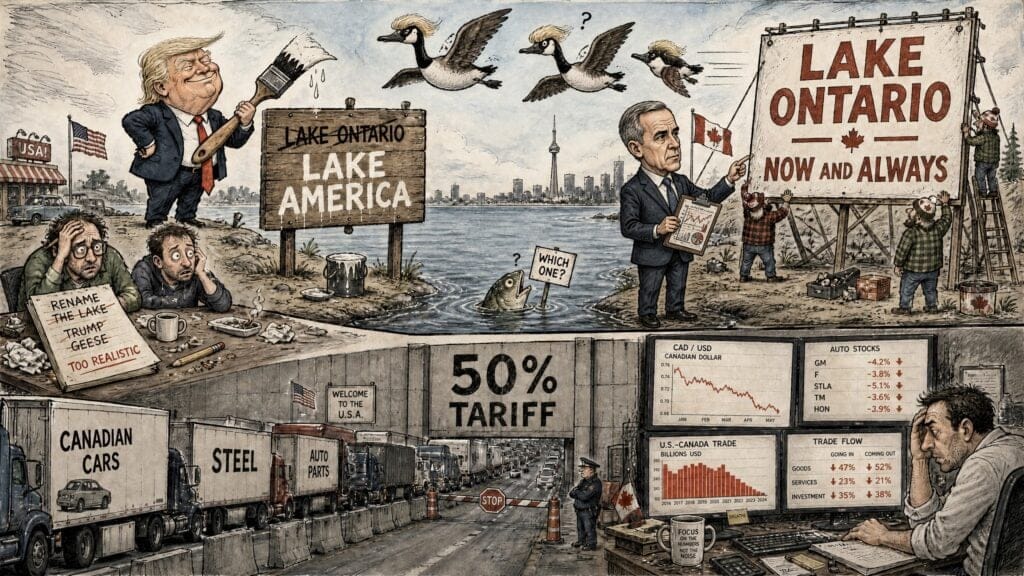
The problem in 2026 is that Parker and Stone are increasingly being denied the exaggeration part, because the President of the United States has now responded to a serious trade dispute with America's closest neighbour by renaming Lake Ontario Lake America, while Canada has erected a gigantic sign saying, essentially, no you haven't, Ottawa residents are considering renaming Trump Avenue, and the president has shared an AI-generated video of armed Canada geese wearing Donald Trump hairstyles and firing rifles beside his newly renamed lake. (Reuters)
What exactly is South Park supposed to do with that? Give the geese bigger guns?
This isn't Trump's first excursion into international cartography. Shortly after returning to office in 2025, he ordered the US government to adopt Gulf of America instead of Gulf of Mexico. The change was subsequently reflected by Google Maps for American users, while people in Mexico continued to see Gulf of Mexico and much of the rest of the world saw both names.
Apparently encouraged by the experience, Trump turned his attention north. The catalyst was the increasingly ugly US-Canada trade dispute. Negotiations between Washington and Ottawa collapsed in August, after which the United States imposed 50% tariffs on roughly $20 billion of Canadian goods. Canada announced retaliatory tariffs, while Trump subsequently threatened 50% duties on Canadian-made cars, trucks, auto parts and steel from January. (Axios)
This is not trivial stuff. The United States and Canada have one of the world's deepest trading relationships, with supply chains — particularly automotive ones — crossing the border repeatedly before a finished product reaches a customer. Decisions made here affect factories, jobs, inflation, currencies and billions of dollars of investment.
So naturally we have reached the stage where we're arguing about what to call a lake.
Trump first announced that America was giving “serious consideration” to changing Lake Ontario to Lake America because, in his words, the US didn't expect to be doing much business with Ontario any longer. Two days later he signed an executive order making the change official for US federal purposes. There is, however, an important limitation to presidential hydrography: Donald Trump can tell the American federal government what to call Lake Ontario, but he cannot tell Canada, international organisations or indeed the lake itself. Canada therefore continues to call it Lake Ontario, as do New York Governor Kathy Hochul and Canadian Prime Minister Mark Carney. Rather inconveniently, the name Ontario comes from an Indigenous Wendat word and predates both the United States and modern Canada. (Washington Post)
Trump has effectively arrived at a lake that has been called Ontario for centuries and announced: mine now.
This is where things begin to deteriorate. Ontario Premier Doug Ford responded by unveiling an enormous sign declaring “Lake Ontario. Now and Always.” Canadian officials and politicians rejected the new name, and Ottawa City Council has meanwhile unanimously started the process that could result in Trump Avenue being renamed. (The Guardian)
Trump Avenue is a small residential street in Ottawa's Central Park neighbourhood, named about 25 years ago as part of an area where streets had New York-related names. Residents have considered changing it before, but suddenly there are some rather more entertaining suggestions: Obama Avenue, Gulf of Mexico Avenue, Canada Goose Avenue and, beautifully, TACO Avenue.
For anyone who missed an earlier edition of Max's Daily Chop, TACO is the Wall Street acronym for Trump Always Chickens Out, coined to describe the pattern whereby Trump announces an enormous tariff, markets panic, negotiations begin, the tariff is delayed or diluted and markets recover. We covered this before, and the central question remains unresolved: is TACO evidence that Trump is a poor negotiator who repeatedly backs down, or is threatening something outrageous and subsequently conceding part of it simply the negotiating strategy?
Canada appears increasingly willing to find out.
To be clear, Ottawa has not renamed the street TACO Avenue. It is one of several suggestions being floated, and residents will ultimately have a say in what happens. But please let it happen. Not for geopolitical reasons; purely for comedy. (Moneycontrol)
Trump's response to all this has been reassuringly presidential. On Saturday he shared an AI-generated video featuring an army of Canada geese, each sporting his distinctive swept-back blond hairstyle and carrying a rifle, marching beside Lake America before opening fire as fireworks explode. It was set to the theme from Hawaii Five-O. (Daily Beast)
Read that again and remember we're discussing relations between two G7 countries.
He also shared another AI video in which an artificial Trump walks up to a Lake Ontario sign, kicks it over, replaces it with Lake America and performs his trademark dance. Meanwhile Ontario has put up its enormous real-world Lake Ontario sign, Google Maps now shows Lake America to American users and Lake Ontario to Canadians, and international users may see both. (Reuters)
We have essentially geopolitically forked reality: if you drive towards the water from Toronto, it's Lake Ontario; approach it from Rochester and your phone may tell you it's Lake America. Somewhere in the middle, presumably, the fish are awaiting clarification from the State Department.
And this is where, as an Englishman, I think I struggle with Trump more than almost anything else, because much of this could be funny. The geese are objectively ridiculous. Calling a street TACO Avenue is funny. A tit-for-tat argument between Canada and America about who gets naming rights over a lake has the raw ingredients of a genuinely good joke.
But humour requires something Trump has never seemed particularly comfortable with: the ability to make yourself part of the joke.
There is a famous piece by British writer Nate White attempting to explain why Trump jars so badly with the British sensibility. White's basic argument was that the British traditionally value qualities such as wit, understatement, self-awareness, humility and the ability to laugh at oneself, whereas Trump represents almost the precise inverse. White makes the useful distinction that Trump can be laughable without himself being particularly witty. (Nate White essay – reproduced by Diane Ravitch)
That's exactly it. British humour has always had a slightly suspicious relationship with people who take themselves extremely seriously. If you announced in a British pub that you were the greatest businessman who had ever lived, someone would ask why your tie was so long. If you said you were the greatest president in American history, someone would probably ask whether Washington had ever managed to bankrupt a casino.
Trump doesn't seem to operate on that frequency, which brings us neatly to the presidential league table.
Amid all this, Trump shared a ranking of American presidents on Truth Social. At the top was a category entitled THE GREATEST, containing precisely one president: Donald Trump. Immediately below, merely GREAT, were Abraham Lincoln, George Washington, Franklin D Roosevelt, Thomas Jefferson and others. Inevitably, Barack Obama and Joe Biden were dumped into FAILURES. (People)
Just think about that for a moment. Lincoln preserves the Union and ends slavery. Washington leads the revolution and establishes the presidency. Franklin Roosevelt leads America through the Depression and most of the Second World War.
Trump gives himself the gold medal.
This isn't The Thick of It. It isn't Veep. It isn't South Park. It's the actual presidential social-media account. We have gone from Caesar crossing the Rubicon, Churchill and Roosevelt discussing grand strategy, Kennedy and Khrushchev staring into the nuclear abyss, Kissinger practising shuttle diplomacy and Reagan negotiating with Gorbachev to a political culture in which “I'm better than Lincoln and I've renamed the lake” doesn't feel entirely out of place.
History has not so much ended as been put in detention.
Strip away the comedy, though, and something considerably less amusing remains. The language increasingly resembles playground politics: you insult me, I insult you; you put tariffs on my goods, I put tariffs on yours; you criticise my policy, I rename your lake; you put up a sign, I post armed geese.
Trump recently dismissed Ontario Premier Doug Ford as Mark Carney's “flunky” and mocked him by comparing him unfavourably with his late brother Rob Ford after the premier criticised Trump's tariff policy. (Washington Post)
It has the emotional sophistication of two boys arranging a fight behind the bike sheds at lunchtime, except one boy controls the world's largest economy and its most powerful military, the other side represents one of America's biggest trading partners, and the bike sheds contain an integrated continental supply chain worth hundreds of billions of dollars.
That's where the joke stops being entirely funny.
The timing is particularly interesting because Canada has just produced some unexpectedly strong economic numbers. Its economy grew at an annualised 3.3% in the second quarter of 2026, the fastest pace since 2023 and well above the Bank of Canada's earlier expectations. Exports rose 3.6%, their strongest increase in more than three years, while consumer spending and business investment also strengthened. (Reuters)
That doesn't make Canada immune to an American trade war. Far from it. The countries are so economically intertwined that sustained tariffs can damage both sides, and economists are already warning that the new measures could undermine Canada's recovery. But it does matter to the negotiating psychology. Carney isn't simply accepting whatever Washington puts in front of him. Canada rejected terms it believed threatened its automotive, steel and aluminium industries and its ability to set parts of its own trade policy, while Trump has responded by telling Canadian leaders to “fall in line”. (Associated Press)
Which takes us back to TACO. The negotiating method works extremely well when the other side believes the threat is unbearable; it becomes rather more complicated when the other side decides to call.
You could reasonably look at the entire episode and dismiss it as theatre. Lake Ontario will continue containing approximately the same quantity of water regardless of what Donald Trump types into Truth Social. Renaming it doesn't change Canadian GDP, American inflation or the price of a Ford F-150.
But the dispute surrounding it absolutely does. Fifty per cent tariffs are real. Retaliatory tariffs are real. Automotive supply chains, the Canadian dollar and the inflationary consequences of making imported goods more expensive are all real. So are the investment decisions companies delay because they don't know what tariff regime will exist in six months.
That's the peculiar problem markets face with Trump: investors have to separate the spectacle from the signal. The armed geese don't matter; the tariff announcement accompanying them might. When both arrive through roughly the same communications channel, sometimes within hours of one another, separating the two becomes a market skill in itself.
I keep wondering how historians will write about this period. History gives us these wonderful shorthand images of power: Caesar at the Rubicon, Elizabeth I at Tilbury, Napoleon at Austerlitz, Churchill in the War Rooms, Kennedy during the Cuban Missile Crisis.
Perhaps ours will be a Canada goose with Donald Trump's hair carrying an assault rifle.
That may sound flippant, but I think there is something genuinely depressing underneath it. Politics has always involved vanity, insults, propaganda and enormous egos. Julius Caesar wasn't exactly short of self-belief. Churchill could be vicious. Lyndon Johnson reportedly conducted political meetings while sitting on the lavatory. Statesmanship has never been quite as stately as the oil paintings suggest.
The difference is that previous generations didn't have AI video generators and social-media accounts capable of transmitting every passing impulse of the world's most powerful people directly to hundreds of millions of phones. We now see the playground argument in real time, and because the participants know we are watching, there is an incentive to perform it.
Maybe that's the strangest thing about the Lake America affair. Not that a president tried to rename a shared lake during a trade dispute, or that Canada responded with a gigantic sign, or that somebody proposed TACO Avenue. It's that none of it feels completely surprising anymore.
South Park used to take reality and make it absurd enough for us to notice. Now reality has caught up. Trey Parker and Matt Stone could pitch an episode tomorrow in which Donald Trump declares himself greater than Abraham Lincoln, renames Lake Ontario after America and deploys an army of machine-gun-wielding geese with his own haircut, and the writers' room would probably tell them to tone it down.
And somewhere beneath all of this nonsense, two of the world's largest economies are conducting a trade war.
Keep your Axe sharp.
And for God's sake, leave the lakes alone.
Max
Want more of The Daily Chop?
Sharp market stories, trading takes and financial madness straight to your inbox.

