

Bitcoin is back above $75,000, which means somewhere in the world somebody who sold at $60,000 is explaining that they "never really believed in it anyway", somebody who bought considerably higher is suddenly checking their account rather more frequently, and several people who owned Bitcoin when it was worth roughly the price of a disappointing lunch are being reminded once again of precisely how rich they could have been.
I was originally going to make today's Chop about some of the most expensive things ever bought with Bitcoin. There are some absolute beauties. In 2013, somebody bought a Lamborghini Gallardo for 216.8 BTC, then worth around $209,000. At today's $75,000 Bitcoin price, those coins would be worth about $16.26 million. An anonymous buyer spent 91.4 BTC on a used Tesla Model S, then worth around $103,000. Those coins are now worth $6.86 million. And in 2014 somebody spent 2,739 BTC, then worth about $1.6 million, buying a 1.4-acre plot near Lake Tahoe. Today, that's $205.4 million. (Bloomberg)
I hope it was a really lovely plot.
But thinking about it, there's a much more interesting story here, because one of the things that makes cryptocurrency so fascinating also creates one of its most terrifying problems: security and access.
We should briefly acknowledge Laszlo Hanyecz and his famous 10,000 BTC pizzas because we covered him recently in our piece on history's greatest bad trades, and there are limits to how often one man should be publicly reminded about his dinner. At $75,000, those coins would now be worth $750 million. But, as we said before, calling it a $750 million pizza is cheating. It cost him about $41 at the time, and somebody actually had to spend Bitcoin if Bitcoin was ever going to become anything more than an interesting collection of numbers on computers.
What's much more interesting to me this time is what happened to the people who didn't spend their Bitcoin at all. In some cases, they still own it. They know exactly where it is. They can see precisely how much it's worth. They just can't get into it.
One of Bitcoin's great attractions is also the source of some of its most extraordinary horror stories. Bitcoin doesn't really sit "on" your phone or hard drive like a Word document. Ownership is recorded on the blockchain, while what allows you to control Bitcoin is the private key associated with the relevant address. Depending on how you hold it, access might ultimately be protected through a wallet, password, seed phrase or hardware device.
And this is rather the point of self-custody. Properly secured, nobody can simply ring up Bitcoin headquarters, impersonate you and ask Brian in customer services to reset the account.
Unfortunately, neither can you.
There is no "Forgot your password?" button on the Bitcoin blockchain, no security question asking for your mother's maiden name and no increasingly exasperated call-centre employee eventually agreeing to let you back in after you've named your first pet and the last four digits of a debit card. Lose the only route to your private keys and the Bitcoin can remain sitting there on the blockchain, perfectly visible and perfectly secure, potentially forever.
Which brings us to Wales.
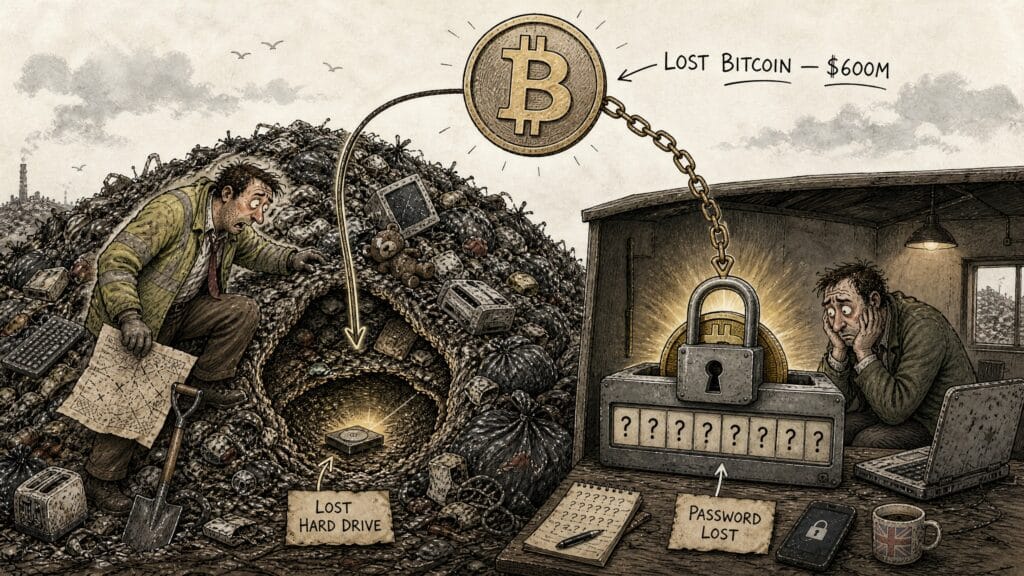
James Howells is probably the most famous man in Britain ever to have regretted taking the bins out.
Howells says he mined 8,000 Bitcoin in 2009. The private key required to access them was stored in a wallet file on a laptop hard drive. During a clear-out in 2013, the hard drive ended up in a black bag and was subsequently taken to the Docksway landfill site in Newport.
At today's $75,000 price, those Bitcoin are worth $600 million.
And here's the particularly exquisite form of torture: Howells can see them. The Bitcoin remain at their original wallet addresses. The blockchain doesn't care that the hard drive required to access them may be underneath a decade's worth of Welsh rubbish. The coins haven't disappeared; he simply can't move them without the key.
Howells has spent more than a decade trying to persuade Newport City Council to let him excavate the landfill. He assembled specialists, secured potential funding and proposed increasingly elaborate recovery operations before eventually going to court. In January 2025, the High Court threw out his claim, ruling that it had no realistic prospect of succeeding. The judgment records his claim that the site contained the hard drive giving access to 8,000 BTC and that without its private key he couldn't transact with them. (High Court judgment)
At one stage he was even considering buying the landfill. He has since said he's no longer pursuing excavation and has instead pivoted towards a plan involving tokenising his legal claim to the inaccessible Bitcoin. (The Block)
There are bad financial decisions, and then there's discovering the bin bag you threw away contained the password to six hundred million dollars.
Then there is Stefan Thomas, a programmer and former Ripple executive who received 7,002 BTC in 2011 for making an educational video explaining Bitcoin. The private keys eventually ended up protected on an encrypted IronKey device.
Thomas lost the password, which would be inconvenient enough were it not for one additional feature: the IronKey allows ten incorrect password attempts before its encrypted contents become permanently inaccessible. Thomas has already tried eight.
At $75,000 per Bitcoin, what's potentially sitting behind those final two guesses is $525,150,000. Imagine typing a password when pressing Enter incorrectly could cost you half a billion dollars. I struggle enough when Ticketmaster tells me I have one attempt remaining.
It gets stranger. In 2023, security researchers at Unciphered demonstrated a technique they said could crack the same model of IronKey without triggering its ten-attempt destruction mechanism. They offered to help Thomas, but he had already engaged other recovery teams and declined their offer. As of this summer, reports still described the 7,002 BTC as inaccessible. (WIRED)
Somewhere inside that story is a wonderful summary of modern finance: half a billion dollars exists, everybody knows where it is, the owner knows it belongs to him, hackers say they can get it, and nevertheless nobody is touching it.
This is where Bitcoin's slightly surreal relationship with access becomes personal.
A very good friend of mine accumulated a reasonable Bitcoin fortune relatively early. He did what you're supposed to do and kept the information required to access it securely written down and locked in a safe. Unfortunately, his wife subsequently tidied the safe and, somewhere in that process, the piece of paper went in the bin.
I should stress that they're still married, which I consider an impressive demonstration of emotional maturity.
His remaining lifeline was an old phone on which he could still access the account. There were several problems. He didn't know the relevant password, the phone was ageing, the battery was decidedly temperamental and his continued access depended on the phone recognising his face. On top of that, there was a limit to how much he could withdraw each day.
So began approximately eighteen months of what I can only describe as the world's most stressful standing order. Every day he would turn on this increasingly precious old phone, present his face to it and hope that today wasn't the day the battery died, the software reset itself, the device stopped recognising him or some other tiny piece of technology decided it had enjoyed enough of this mortal coil. Or that largesse had registered his face unrecognisable; Dorian Gray’s portrait in reverse. Assuming all went well, he withdrew another chunk.
The phone travelled everywhere with him. Obviously. By this point it wasn't really a phone anymore; it was a small electronic hostage negotiation containing a significant portion of his wealth.
Eventually, he got the money out. But for eighteen months the difference between having a Bitcoin fortune and potentially losing access to one was an elderly mobile telephone successfully recognising his nose. One, that he insisted on repeatedly breaking on the cricket pitch.
There's another side to all these stories, though, and it's the same reason I don't particularly enjoy laughing at the Bitcoin pizza guy.
Hindsight is the greatest trading system ever invented. Look backwards and everything becomes wonderfully straightforward. Of course you should have bought Bitcoin when it was $100 and held it. Obviously you shouldn't have spent 2,739 BTC on some land. Obviously you should have sold at the peak, bought back at the bottom and then held it all the way up again.
Imaginary You is an astonishing trader. Imaginary You never panics, never needs the money and never gets nervous during a 40% fall. He can apparently watch £10,000 become £20,000 without once considering that doubling his money might be quite a nice result, because Imaginary You possesses one analytical advantage unavailable to the rest of us: he knows what happened next. He’s also hung like a baboon.
Real You gets the unfinished chart. And an underpants macaque.
And that's particularly relevant today. Bitcoin has just climbed back through $75,000 for the first time since May, after a sharp rally that has once again woken up the crypto market. (CoinDesk)
So is $75,000 cheap or expensive? Is this the beginning of another enormous run, or a wonderful opportunity to take profits before the next collapse? I'll happily tell you in 2036. By then I'll be an absolute expert.
That's the lesson connecting the people who spent Bitcoin too early, the people who lost access to it and everybody trading it today. You don't get to make decisions with tomorrow's chart already printed. You make the best decision you can with the information available now, manage the risk and protect the downside. And if you're going to self-custody several hundred million dollars of Bitcoin, perhaps make more than one bloody copy of the password.
Because sometimes the worst trade isn't buying at the top or selling at the bottom.
Sometimes it's tidying the safe.
Keep your Axe sharp.
And your passwords somewhere safer.
Max
Want more of The Daily Chop?
Sharp market stories, trading takes and financial madness straight to your inbox.

