

The US $14B weapons package for Taiwan is drawing global attention as Washington considers one of the largest defense deals for the island in recent years. The proposed package includes advanced PAC-3 missile defense systems and NASAMS air defense platforms, both designed to strengthen Taiwan’s ability to defend itself against potential missile and aerial threats.
Reports also suggest that an additional $6 billion in asymmetric defense weapons could be approved to further strengthen Taiwan’s military strategy. The timing of the announcement is especially sensitive because it may coincide with President Donald Trump’s upcoming visit to China, a development that could intensify already fragile relations between Washington and Beijing.
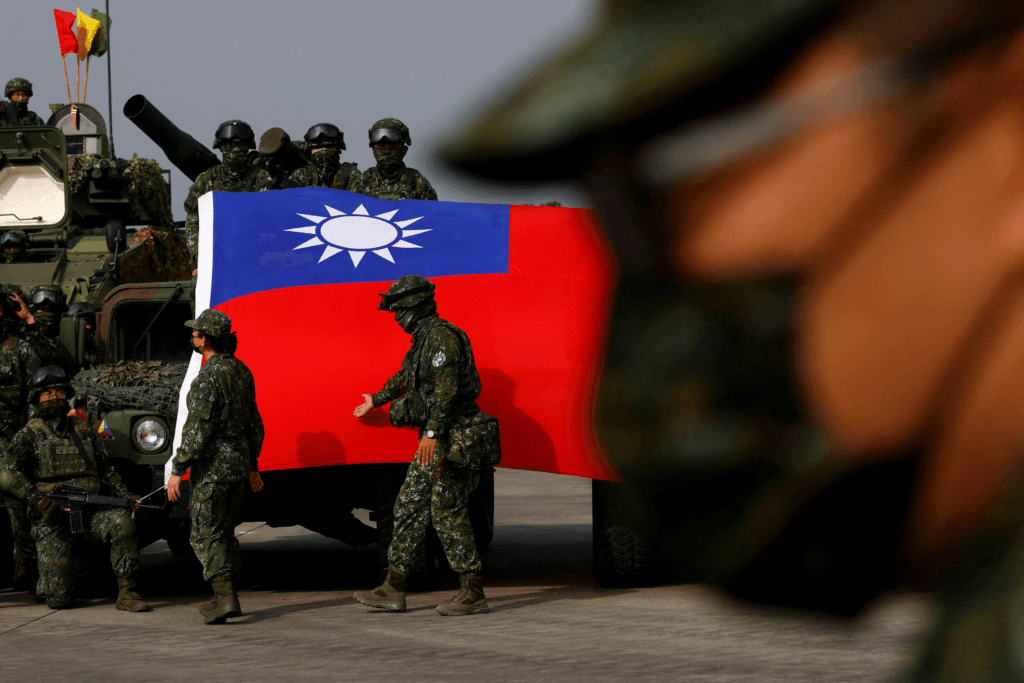
The US $14B weapons package for Taiwan aims to strengthen Taiwan’s defensive capabilities in response to growing security concerns in the Taiwan Strait.
Under the Taiwan Relations Act, the United States is authorized to provide defensive arms to Taiwan to help maintain regional stability. According to defense analysts, the package will focus primarily on missile defense, air defense, and rapid-response systems that could help Taiwan counter potential attacks.
You can read more about the Taiwan Relations Act through the official resource from the U.S. Department of State.
The centerpiece of the US $14B weapons package for Taiwan is expected to include two major defense systems.
The Patriot Advanced Capability-3 (PAC-3) system is designed to intercept incoming ballistic missiles, cruise missiles, and aircraft. It provides a critical layer of protection against missile threats.
PAC-3 interceptors are widely considered among the most effective missile defense technologies currently available.
Another key component of the US $14B weapons package for Taiwan is the National Advanced Surface-to-Air Missile System (NASAMS).
NASAMS has been deployed by multiple NATO countries and recently gained global attention for its effectiveness in Ukraine’s air defense strategy.
Learn more about NASAMS through the NATO official website.
Together, PAC-3 and NASAMS could significantly improve Taiwan’s multi-layered air defense network.
In addition to traditional air defense systems, the US $14B weapons package for Taiwan may include $6 billion worth of asymmetric defense weapons.
Asymmetric defense focuses on weapons that allow smaller forces to challenge larger military powers effectively. These systems may include:
This strategy is often described as a “porcupine defense”, designed to make Taiwan extremely difficult to invade.
The US $14B weapons package for Taiwan is not only about military cooperation. Taiwan also holds major geopolitical and economic importance.
Taiwan sits along the first island chain, a strategic defense line in the Western Pacific. It also plays a vital role in global technology supply chains, especially semiconductor manufacturing.
For example, Taiwan is home to TSMC, the world’s largest semiconductor manufacturer. Disruptions in Taiwan could therefore impact global technology markets.
For further context on Taiwan’s semiconductor importance, see Brookings Institution analysis.
China considers Taiwan part of its territory and has repeatedly opposed US arms sales to Taiwan.
Because of this stance, the US $14B weapons package for Taiwan could trigger diplomatic tensions between Washington and Beijing.
In the past, large arms sales have led China to:
If the package is confirmed around President Trump’s China visit, it could become a major geopolitical flashpoint.
The US $14B weapons package for Taiwan could significantly reshape security dynamics across the Indo-Pacific region.
Supporters argue that strengthening Taiwan’s defenses helps maintain regional stability and deter conflict. Critics warn that the move could escalate tensions between the world’s two largest powers.
As geopolitical competition intensifies, the US $14B weapons package for Taiwan may become one of the most closely watched defense developments of the year.
Follow for more daily market insights.
Latest News: U.S. Inflation CPI 2.4%: February CPI Report Raises Inflation Concerns

