

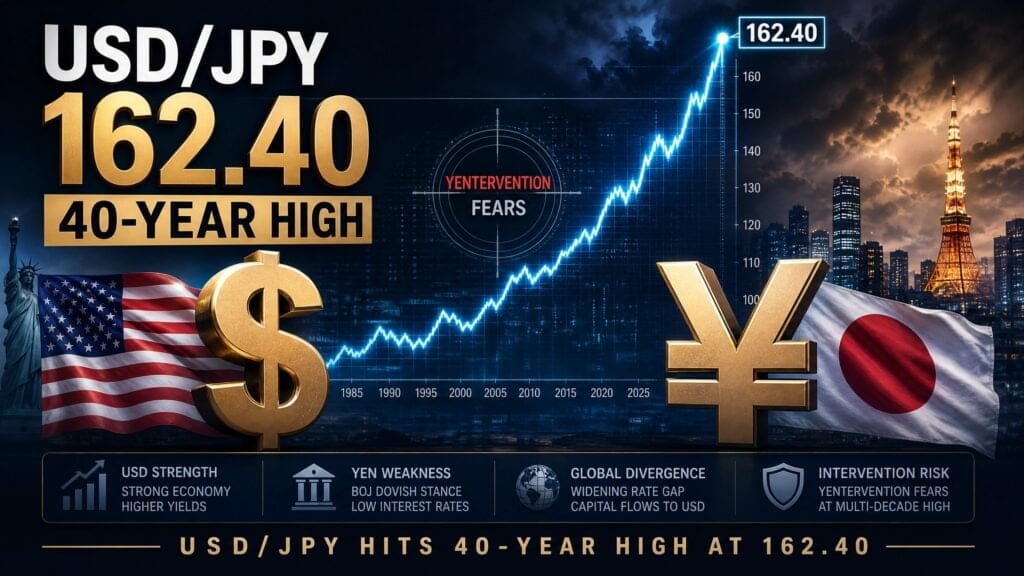
USD/JPY Trades Near 162.40 as the currency pair continues to hover around multi-decade highs in the foreign exchange market. The move keeps traders alert to possible “Yentervention” from Japanese authorities, especially as volatility in currency prices increases and speculation builds around official action.
The currency pair has been driven mainly by interest rate differences between the United States and Japan. The Federal Reserve continues to hold rates at a relatively high level to control inflation, while the Bank of Japan maintains a more cautious tightening path. This gap continues to support the U.S. dollar and weigh on the yen.
For market participants, USD/JPY remains one of the most watched instruments in global currency trading, not only because of its liquidity but also because it reacts quickly to shifts in yield expectations and policy signals.
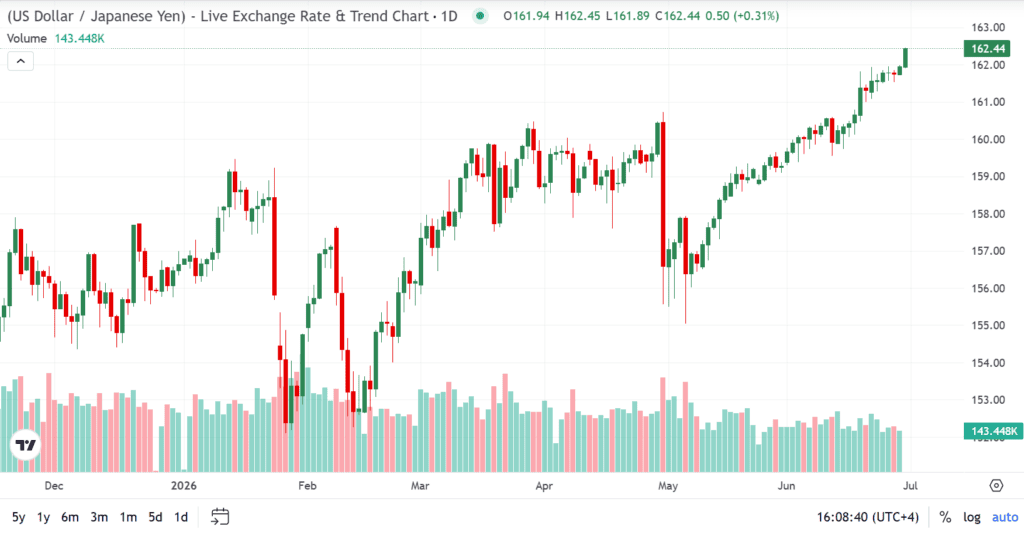
USD/JPY Trades Near 162.40 mainly because of strong structural drivers in the global forex market.
Higher U.S. Treasury yields continue to attract capital into dollar-denominated assets. This keeps demand for the U.S. dollar strong across foreign currencies, including the Japanese yen.
At the same time, the Bank of Japan is still moving cautiously. Even though Japan has started to move away from ultra-loose monetary policy, changes remain gradual. This creates a persistent policy gap between the United States and Japan.
The result is a steady imbalance in flows. Investors prefer holding or borrowing in yen while investing in higher-yielding U.S. assets. This is known as the carry trade and remains a key reason USD/JPY Trades Near 162.40.
The market is a global system, and this pair reflects that reality clearly. Capital moves quickly across borders based on interest rate expectations, risk sentiment, and macroeconomic data.
“Yentervention” is a trader nickname used to describe direct intervention by Japanese authorities in the currency market. It combines “yen” and “intervention” and refers to actions taken to stabilize the currency when moves are considered too fast or one-sided.
Japan’s Ministry of Finance is responsible for deciding intervention policy, while the Bank of Japan typically executes the operations.
Intervention usually involves selling foreign currencies and buying yen in large amounts. This can cause sharp price movements in USD/JPY within minutes.
Officials do not target a specific exchange rate. Instead, they focus on whether the market is moving in an orderly way. When volatility becomes extreme, intervention becomes more likely.
USD/JPY Trades Near 162.40 is important because it places the pair in a zone where traders begin to expect verbal warnings or even actual intervention risk.
The risk of intervention rises when the yen weakens too quickly. It is not just the level that matters, but the speed of the move.
Recent price action shows sustained pressure on the yen, driven by strong U.S. economic data and higher yields. This creates conditions where officials may become uncomfortable with further rapid depreciation.
In past episodes, Japanese authorities stepped in after sharp moves in the foreign exchange market caused concern among policymakers and businesses.
For example, when USD/JPY moves aggressively in a short period, it can distort expectations for import costs, inflation, and corporate planning inside Japan.
That is why traders closely monitor official comments from the Ministry of Finance. Even verbal warnings can temporarily slow momentum in currency trading.
USD/JPY is one of the most actively traded pairs in the forex market and plays a key role in global currency trading.
The pair reflects the relationship between two major economies: the United States and Japan. Because of this, it often reacts to global risk sentiment, bond yields, and central bank policy expectations.
The foreign exchange market operates 24 hours a day, allowing continuous trading across Asia, Europe, and the United States. This makes USD/JPY highly responsive to news flow and macroeconomic releases.
For many market participants, USD/JPY is also a signal currency. When it moves strongly, it often reflects broader shifts in global capital flows.
Even though USD/JPY Trades Near 162.40, the next major move will likely depend on economic data and policy signals.
In the United States, traders are focused on inflation data, labor market reports, and Federal Reserve commentary. These events influence expectations around interest rates, which directly affect the dollar.
In Japan, attention remains on inflation trends, wage growth, and any shift in Bank of Japan policy stance. Stronger domestic data could support expectations of tighter policy and help stabilize the yen.
Market participants are also watching yield movements in U.S. Treasuries. Higher yields generally support USD/JPY, while declines can trigger pullbacks.
When USD/JPY Trades Near 162.40, traders often adjust their behavior due to potential intervention risk.
Some reduce position sizes, while others widen stop-loss levels to avoid being caught in sudden volatility. In some cases, traders step aside completely during periods of high uncertainty.
Intervention risk introduces a unique challenge in the forex market. Unlike normal price movements, intervention can cause rapid and unpredictable reversals.
This is why risk management becomes more important when the pair approaches historically sensitive levels.
USD/JPY Trades Near 162.40 reflects a strong structural trend driven by interest rate differences and global capital flows. The United States continues to offer higher yields, while Japan maintains a more cautious policy stance.
However, rising speculation around “Yentervention” adds an extra layer of risk for traders. While fundamentals continue to support the dollar, the possibility of sudden intervention means price action can change quickly.
For now, USD/JPY remains a key focus in global currency trading, and market participants will continue watching both economic data and official commentary closely.
Stay updated with real-time forex insights and analysis at the FX Axe Telegram Channel.
Read more:
Best ASIC Regulated Forex Brokers: Ultimate 2026 Guide
MT4 Vs MT5: The Ultimate Guide To Choosing The Best Trading Platform

