

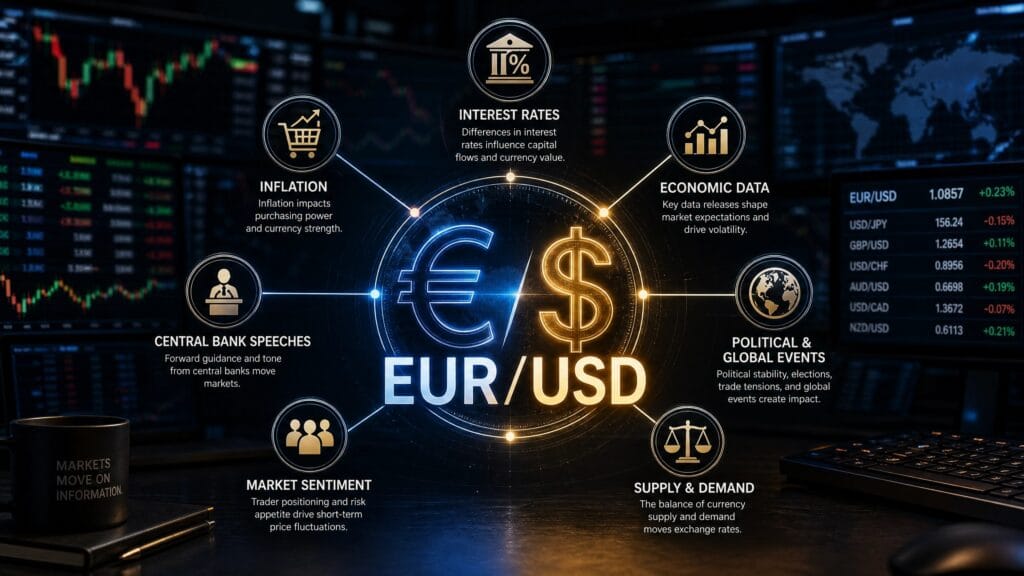
If you've ever opened a forex chart, chances are EUR/USD was one of the first currency pairs you noticed. It is the most traded pair in the world, accounting for a large share of daily forex trading volume.
But one question every beginner eventually asks is: what actually moves EUR/USD?
The good news is that you don't need to be an economist to understand it. Once you know the main drivers behind the market, price movements become much easier to follow.
In this guide, we'll explain the biggest factors that influence EUR/USD using simple language and real-world examples.
Read about what's happening in EUR/USD today: EUR/USD Faces Critical Test Near 1.1350 Ahead Of The Fed Decision
The biggest answer to what actually moves EUR/USD is interest rates.
The euro is managed by the European Central Bank (ECB), while the US dollar is managed by the Federal Reserve (Fed). When either central bank raises or lowers interest rates, it can have a major impact on the exchange rate.
Higher interest rates usually make a currency more attractive because investors can earn better returns by holding assets in that currency. For example, if the Federal Reserve raises rates while the ECB keeps rates unchanged, the US dollar often strengthens and EUR/USD may fall.
This is why traders closely watch every ECB and Fed meeting.
Another important factor in what actually moves EUR/USD is inflation.
Inflation measures how quickly prices are rising in an economy. Central banks pay close attention to inflation because it influences future interest rate decisions.
If inflation remains higher than expected in the United States, markets may expect the Federal Reserve to keep interest rates higher for longer. That often supports the US dollar and puts pressure on EUR/USD.
The same principle applies to the Eurozone.
Every week, governments release economic reports that give investors a snapshot of how the economy is performing.
Some of the most important reports include:
These reports often create sharp market moves because they can change expectations about future interest rates. That's another reason what actually moves EUR/USD is a popular question among new traders.
It's not just interest rate decisions that matter.
Markets also react when central bank officials speak. Even small changes in wording during a press conference can move EUR/USD within minutes.
If Federal Reserve officials sound confident about the US economy, traders may buy more US dollars. If European Central Bank officials suggest stronger economic growth in Europe, the euro could gain strength instead.
Listening to what policymakers say is an important part of understanding what actually moves EUR/USD.
Politics can also influence currency prices.
Events such as elections, trade disputes, geopolitical tensions, or unexpected government policies can increase uncertainty in financial markets.
During uncertain periods, investors often move money into assets they consider safer, including the US dollar. That is why major global news can cause EUR/USD to rise or fall even when no economic reports are released.
Sometimes markets move simply because of investor confidence.
If traders believe the global economy is improving, they may take on more risk and reduce their demand for safe-haven currencies.
If fear returns to the market, many investors buy the US dollar because it is considered one of the world's safest reserve currencies.
Understanding market sentiment is another key part of learning what actually moves EUR/USD.
At the end of the day, every price move comes down to buyers and sellers.
When demand for euros is greater than demand for US dollars, EUR/USD rises.
When investors prefer holding US dollars, EUR/USD falls.
Large institutions, hedge funds, banks, multinational companies, and even governments all contribute to this daily buying and selling activity.
That is the simplest explanation for what actually moves EUR/USD.
One of the easiest ways to prepare for market volatility is by checking an economic calendar before placing a trade.
High-impact events like Federal Reserve meetings, ECB decisions, inflation reports, and Non-Farm Payrolls often lead to larger price swings. Knowing when these events are scheduled can help you avoid unexpected volatility and make more informed trading decisions.
If you're still wondering what actually moves EUR/USD, remember that no single factor controls the market all the time. Instead, currency prices react to a combination of interest rates, inflation, economic data, central bank decisions, political events, market sentiment, and overall supply and demand.
The more you understand these drivers, the easier it becomes to make sense of daily market movements instead of reacting to every price swing.
For more beginner-friendly trading education, broker reviews, and daily market updates, subscribe to the FX Axe YouTube channel.

