


The US dollar falls after soft CPI headline dominated global financial markets after June's inflation data came in lower than expected.
The latest Consumer Price Index (CPI) showed inflation slowing to 3.5% year-over-year, encouraging investors to scale back expectations that the Federal Reserve will continue raising interest rates aggressively.
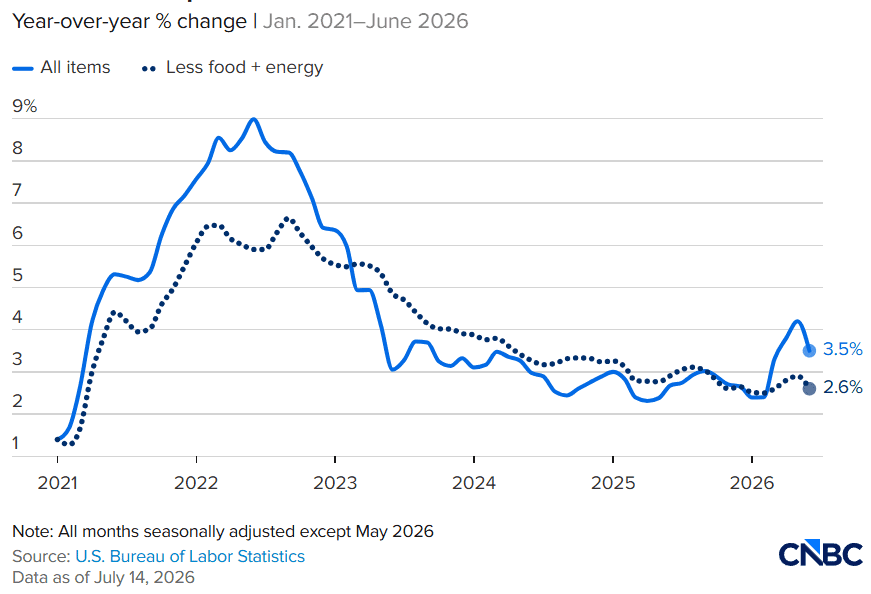
The softer inflation report quickly changed market sentiment. U.S. Treasury yields moved lower as traders adjusted their outlook for future monetary policy, placing fresh pressure on the greenback.
As a result, the U.S. Dollar Index (DXY) remained around 100.9, while major currencies including the euro, British pound, Australian dollar, and New Zealand dollar all strengthened against the U.S. dollar.
The market reaction extended beyond currencies.
As the US dollar falls after soft CPI, both gold and oil attracted strong buying interest. Gold gained as lower Treasury yields reduced the opportunity cost of holding the precious metal, while the weaker dollar made gold more attractive for international investors.
Oil prices also moved higher as improving market sentiment and expectations of a less aggressive Federal Reserve supported optimism about future global energy demand.
For forex traders and investors, understanding why the US dollar falls after soft CPI is important because inflation remains one of the strongest drivers of currencies, commodities, and overall financial markets.
The biggest reason the US dollar falls after soft CPI is the direct relationship between inflation and monetary policy.
When inflation remains elevated, the Federal Reserve typically raises interest rates to slow economic activity and bring price growth back toward its target.
Higher interest rates generally support the U.S. dollar because they attract foreign investment into dollar-denominated assets.
However, June's CPI report showed inflation cooling more than economists expected.
The softer reading suggested price pressures may finally be easing, reducing the urgency for additional aggressive interest rate increases.
Although Federal Reserve officials continue emphasizing that future decisions will depend on incoming economic data, investors are increasingly pricing in a slower pace of monetary tightening.
That shift in expectations is one of the main reasons the US dollar falls after soft CPI became the biggest forex story of the day.
Another major reason the US dollar falls after soft CPI is the decline in U.S. Treasury yields.
Treasury yields and the dollar usually move together because higher yields attract investors seeking stronger returns from government bonds. When yields decline, holding dollar-denominated assets becomes less attractive, reducing demand for the currency.
Following the inflation report, Treasury yields slipped as markets priced in fewer interest rate increases over the coming months.
Lower bond yields reinforced the dollar's weakness and encouraged investors to rotate into other major currencies and assets.
This relationship between inflation, bond yields, and the dollar remains one of the most important concepts for forex traders to understand.
The US dollar falls after soft CPI narrative was reflected across nearly every major currency pair.
The DXY stayed around 100.9, remaining well below recent highs as investors continued reducing long-dollar positions.
Several major currencies benefited from the weaker greenback:
The broad gains across the forex market demonstrate how quickly inflation data can reshape investor expectations and currency valuations.
The US dollar falls after soft CPI story did not stop with currencies.
Commodity markets also reacted strongly to the softer inflation report.
Gold extended its gains after Treasury yields declined and the dollar weakened.
Since gold does not generate interest income, lower bond yields reduce the opportunity cost of holding the precious metal.
At the same time, a weaker dollar makes gold less expensive for buyers using other currencies, increasing global demand.
Oil prices also moved higher during the session.
While ongoing geopolitical developments and supply concerns continued supporting crude oil, softer U.S. inflation improved overall market sentiment.
Investors viewed the inflation report as a sign that borrowing costs may not rise as aggressively as previously expected, potentially supporting economic growth and future fuel demand.
The simultaneous rise in gold and oil highlights how one economic report can influence multiple asset classes at the same time.
Although inflation slowed in June, markets remain highly focused on upcoming U.S. economic data.
The US dollar falls after soft CPI trend could continue if future inflation reports confirm that price pressures are easing.
Employment figures, retail sales, producer inflation, and speeches from Federal Reserve officials will all play a major role in shaping expectations for future interest rates.
Forex traders should also continue monitoring Treasury yields, as they often provide early signals about the direction of the U.S. dollar.
If yields remain under pressure, the dollar could struggle to recover.
However, stronger-than-expected economic data could quickly revive expectations for tighter monetary policy and support the greenback.
The US dollar falls after soft CPI story marks one of the most significant market developments of July 2026.
June's inflation slowed to 3.5%, prompting traders to reduce expectations for aggressive Federal Reserve rate hikes and pushing Treasury yields lower.
As a result, the DXY remained around 100.9, while the euro, British pound, Australian dollar, and New Zealand dollar all strengthened against the greenback.
Gold and oil also rallied as investors responded to the weaker dollar and improving market sentiment.
Whether this trend continues will depend on future inflation reports and Federal Reserve policy decisions.
For now, the US dollar falls after soft CPI narrative remains a key driver across forex, commodities, and global financial markets, making it an important story for every trader and investor to follow.
For more forex education, market insights, and daily trading updates, join the FX Axe Youtube Channel.
Read more:
Top 10 CPI Volatility Strategy Tips For Gold Traders: A Complete Guide
Fed's Goolsbee: June CPI Inflation Data Was Surprisingly Benign
CPI Vs PPI: The Ultimate Guide To Avoid Costly Trading Mistakes In 2026

